
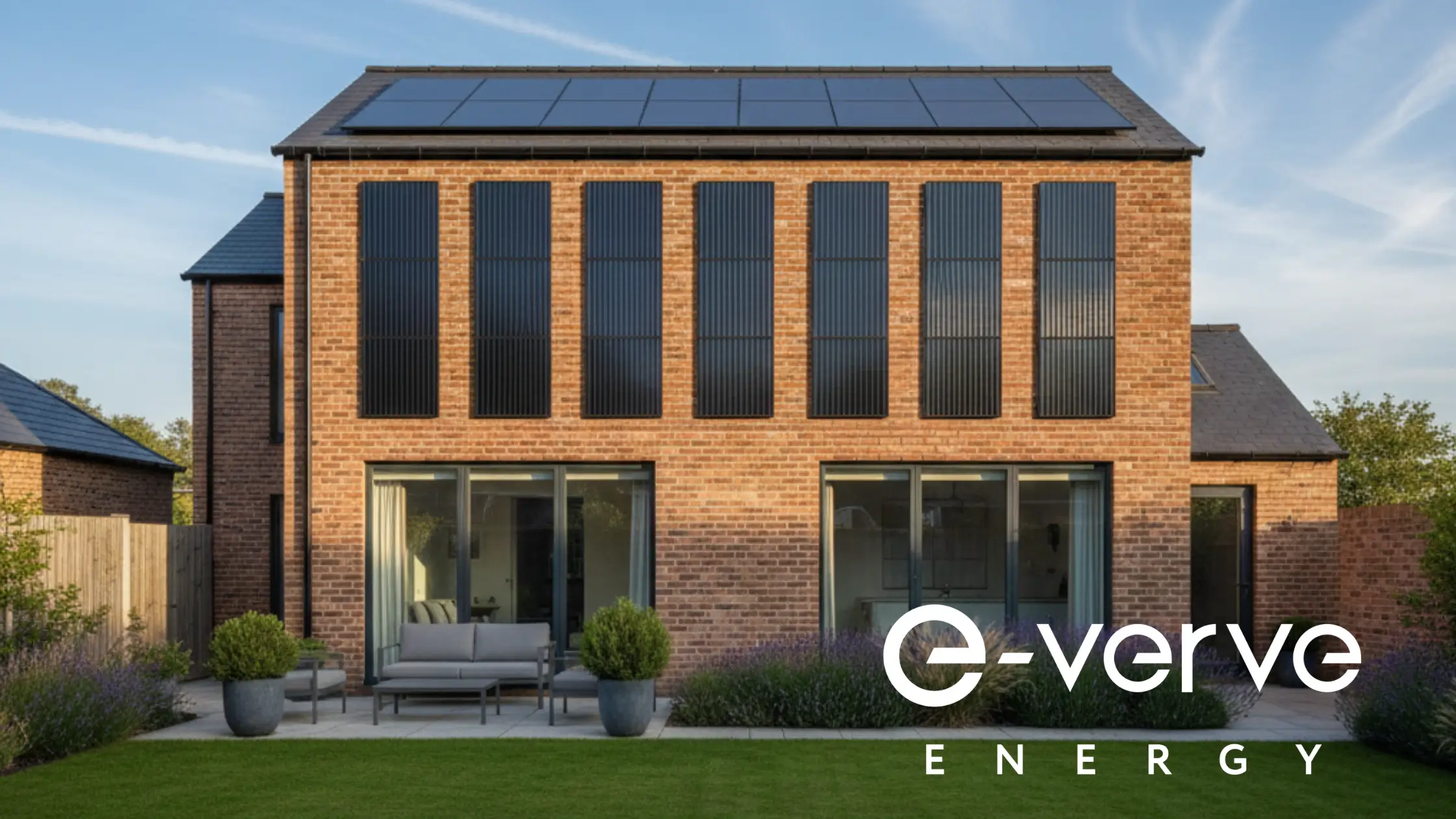
Wall Mounted Solar Panels: Are They Right For You?

Wall Mounted Solar Panels: A Complete Guide

Most people picture solar panels sitting neatly on a slanted roof however, wall mounted solar panels are a great choice if you don’t have suitable roof space or have already made the most of the space available. Vertical solar panels offer a creative alternative that transforms additional spaces of your home into energy-generating assets.

Whilst roof mounted panels are the classic image of renewable energy- what if your roof isn’t suitable? Maybe it faces the wrong way, is shaded by trees, or simply doesn’t have enough space. If you are looking to lower your energy bills but lack the perfect roof, mounting panels on your wall might be the solution you’ve been searching for.

This guide will walk you through everything you need to know about wall mounted solar panels, from installation and costs to performance comparisons with traditional roof systems.

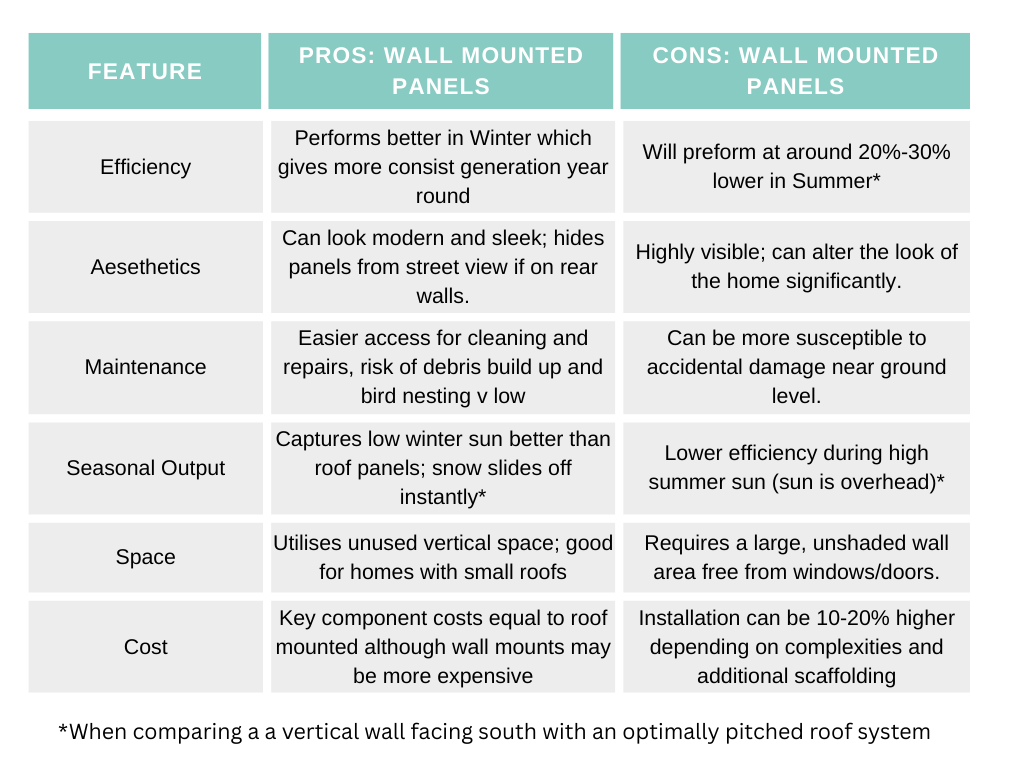
Efficiency

Performs better in Winter which gives more consistent generation year round

Will preform at around 20%-30% lower in Summer*

Aesthetics

Can look modern and sleek; hides panels from street view if on rear walls.

Highly visible; can alter the look of the home significantly.

Maintenance

Easier access for cleaning and repairs, risk of debris build up and bird nesting very low

Can be more susceptible to accidental damage near ground level.

Seasonal Output

Captures low winter sun better than roof panels; snow slides off instantly*

Lower efficiency during high summer sun (sun is overhead)*

Space

Utilises unused vertical space; good for homes with small roofs

Requires a large, unshaded wall area free from windows/doors.

Cost

Key component costs equal to roof mounted although wall mounts may be more expensive

Installation can be 10-20% higher depending on complexities and additional scaffolding

*When comparing a a vertical wall facing south with an optimally pitched roof system

What Are Wall Mounted Solar Panels?

Wall mounted solar panels are exactly what they sound like: photovoltaic (PV) modules installed vertically on the exterior walls of a building rather than on the roof. They function on the same principles as roof-mounted systems, converting sunlight into electricity to power your home.

The primary difference lies in the orientation and angle. While roof panels are typically angled between 30 and 40 degrees to catch the midday sun, wall mounted solar panels are installed at a 90-degree angle. This setup can be particularly useful for buildings with flat roofs, insufficient roof space, or roofs that are structurally compromised.

Can Solar Panels Be Wall Mounted in the UK?

Yes, solar panels can absolutely be wall mounted in the UK. While less common than roof installations, they are a viable and legal option for generating renewable energy.

The UK’s latitude means the sun is often lower in the sky, especially during winter. Surprisingly, wall mounted solar panels can capture this low-angle winter sun quite effectively. They are also less prone to snow accumulation, which can block roof panels during the colder months.

Do You Need Planning Permission for Wall Mounted Solar Panels in the UK?

One of the most common questions homeowners ask is about regulations. Generally, the installation of solar panels on residential land is considered ‘Permitted Development,’ meaning you often do not need to apply for planning permission. However, there are stricter rules for wall mounted solar panels compared to roof systems.

For your installation to fall under Permitted Development, it must usually meet these criteria:

  • The panels must not protrude more than 200mm from the wall surface.
  • If your property is in a Conservation Area or a World Heritage Site, panels cannot be installed on a wall that faces a highway.

If your building is listed, you will almost certainly need Listed Building Consent. It is always wise to check with your Local Planning Authority (LPA) before starting any work to ensure your wall mounted solar panels comply with local rules.

Costs of Wall Mounted Solar Panels

When budgeting for renewable energy, cost is a major factor. The hardware for wall mounted solar panels—the panels themselves and the inverter—costs roughly the same as a roof-mounted system.

However, the installation costs can differ.

  • Scaffolding: Vertical installations often require more complex scaffolding setups than standard roof jobs.
  • Mounting Systems: Specialised vertical mounting frames can sometimes be more expensive than standard roof hooks and rails.

Generally, you can expect the total cost to be slightly higher or comparable to a roof system, depending on the complexity of your wall surface. While a standard 4kW roof system might cost between £6,000 and £8,000, a similar wall mounted system could push towards the higher end of that bracket or slightly above due to the labor involved.

Pros and Cons of Wall Mounted Solar Panels

Deciding to install solar on your walls involves weighing the benefits against the drawbacks. Here is a breakdown to help you decide.
comparison chart of wall mounted solar panels pros and cons #wallmountedsolarpanels #verticalsolarpanels

How Are Wall Mounted Solar Panels Installed?

Installing wall mounted solar panels requires careful planning to ensure safety and efficiency.

  • Pre-Installation Preparation and Checks

Before drilling begins, a structural survey is essential. Walls must be strong enough to support the weight of the panels and withstand wind loads. Installers will check for:

  • Wall material (brick, stone, cladding).
  • Presence of electrical wiring or plumbing within the walls.
  • Shading factors like trees, fences, or neighboring buildings.
  • Recommended Brackets and Hardware

Standard roof rails usually aren’t sufficient. Installers use specialised façade mounting systems. These brackets are designed to anchor deep into the masonry to handle the “pull-out” force generated by wind hitting the flat surface of the panel.

  • Optimal Angles and Directions

For the UK, the ideal direction for wall mounted solar panels is facing South. Since you cannot easily tilt the panels away from the wall without creating wind issues and looking unsightly, they are almost always mounted flush (vertically). While this sacrifices some summer generation, it maximises the surface area exposed to the southern horizon.

Do Vertical Solar Panels Need More Maintenance Than Roof Panels?

Actually, wall mounted solar panels often require less maintenance than their roof-mounted counterparts.

Because they are vertical, gravity does a lot of the work for you. Rainwater washes over them quickly, cleaning off dust and grime more effectively than on a shallow pitched roof. Leaves, twigs, and bird droppings are far less likely to settle on a vertical surface.

Furthermore, if they do need a manual clean or a technical check, they are often reachable with a simple ladder or even from the ground, eliminating the need for expensive scaffolding or dangerous roof climbing.

Performance Comparison: Wall Mounted vs. Roof Mounted Solar Panels

This is the deal-breaker for many: how much power will you actually generate?

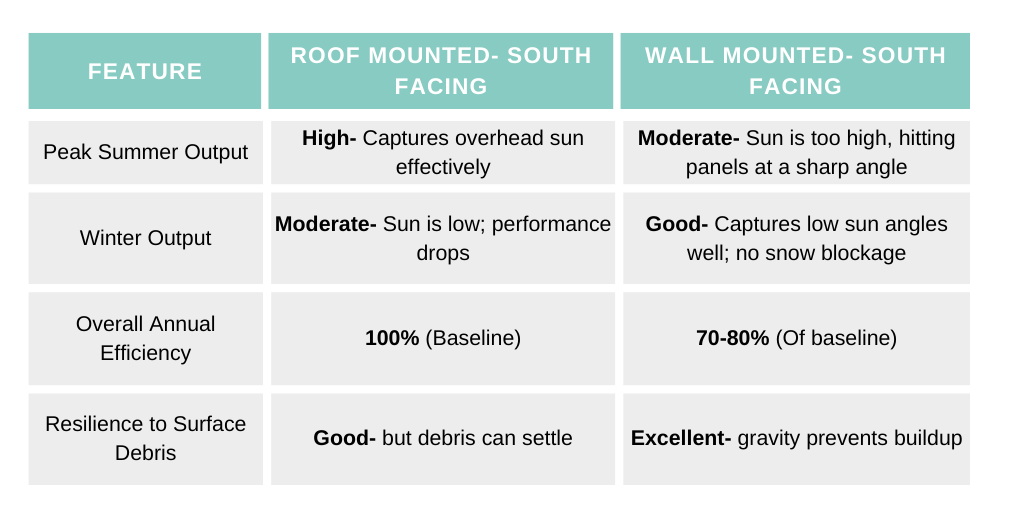
Physics dictates that solar panels work best when the sun hits them at a perpendicular angle. In the UK summer, the sun is high; in winter, it is low. Roof panels compromise to catch the most sun year-round. Wall mounted solar panels sacrifice summer peaks but gain winter consistency.

Generally, a vertical wall facing south will generate about 70% to 80% of the energy that an optimally pitched roof system would produce over the course of a year.
Roof mounted v wall mounted solar panels comparison chart #wallmountedsolarpanels #verticalsolarpanels

Are Wall Mounted Solar Panels the Right Choice for My Home?

Wall mounted solar panels are rarely the first choice if you have a perfect, unshaded, south-facing roof. The physics of solar generation simply favors a tilt.

However, they are the right choice if:

  • Your roof is unsuitable: It faces North, is structurally weak, or is heavily shaded.
  • You need a boost: You already have roof panels and want to add more capacity to your system.
  • You live in snowy areas: You want consistent winter power without snow covering the panels.
  • You love the aesthetic: You want to make a visual statement with a modern solar façade.
  • Maintenance access is key: You want a system that is easy to reach and clean.

Conclusion

Wall mounted solar panels are an innovative solution that opens up solar energy to homes that might otherwise miss out. While they may not match the total annual output of a perfectly pitched roof system, their unique benefits—like better winter performance, self-cleaning properties, and ease of access—make them a compelling option for many UK homeowners.

By turning your walls into power stations, you can reduce your carbon footprint and take control of your energy bills, regardless of your roof situation.

How Can E-Verve Energy Help?

Navigating the options for solar energy can be complex, especially when considering non-standard installations like wall mounting. At E-Verve Energy, we specialise in bespoke renewable energy solutions tailored to your specific property.

Our team of experts can conduct a full structural and shading analysis of your property to determine if wall mounted solar panels are feasible for you. We handle everything from the initial design to the final installation and commissioning.

Every installation is carried out by our certified professionals who strictly adhere to the Microgeneration Certification Scheme (MCS) and all relevant UK regulations. This not only gives you peace of mind but also secures your eligibility for government incentives like the Smart Export Guarantee (SEG).

From the first consultation through installation and aftercare, E-Verve Energy delivers expert advice, high-quality workmanship, and ongoing support—helping you make the most of your investment!

Whether you’re a homeowner or running a commercial property, we provide trusted advice and a personalised experience. Helping you harness reliable solar power, reduce energy bills and increase green credentials.

Get Your Custom Solar Quote Today

Select your ideal setup and receive a tailored quote in minutes.

90+ Google Reviews

Have more questions?

That’s okay, we’ve answered some of the more commonly asked questions here but if you still have questions, just get in touch and we’ll be happy to provide any support you need.

If you already have a solar photovoltaic (PV) system on your roof, you’re familiar with the benefits of generating your own clean energy. But what if you want to produce even more power? Perhaps your energy needs have grown, or you’re looking to maximise your home’s potential. This is where you might wonder: can wall mounted solar panels be integrated into my current PV system?

The short answer is yes, it is absolutely possible. Adding vertical solar panels to an existing setup is an excellent way to boost your energy production. However, it requires careful planning and a few technical considerations to ensure the entire system works together safely and efficiently.

Compatibility with Your Current PV System

Integrating new panels into an established system isn’t as simple as just connecting them. The success of the project depends on the compatibility of the new vertical solar panels with your existing hardware, especially the inverter.

Your inverter is the heart of your solar energy system, converting the direct current (DC) from the panels into alternating current (AC) for your home. It has a maximum capacity for how much DC power it can handle. If you add more panels, you need to be certain your inverter can manage the increased load.

There are generally three scenarios:

  1. Sufficient Inverter Headroom: If your original installer fitted an inverter with a larger capacity than your roof array required, you may have enough “headroom” to add the new wall mounted solar panels without needing a major upgrade.
  2. Inverter Upgrade: If your current inverter is already operating at or near its maximum capacity, you will need to replace it with a larger model that can handle the combined output of both your roof and wall panels.
  3. Adding a Second Inverter: In some cases, it may be more practical to install a second, smaller inverter dedicated solely to the new wall mounted solar panels. This can be a good option if the new panels have different characteristics from the old ones.
Technical Requirements for Integration

Before proceeding, a qualified solar installer will need to perform several technical checks to ensure a seamless integration.

Inverter and System Checks

The first step is a thorough assessment of your current inverter. The installer will check its maximum DC input voltage and current ratings. Solar panels connected in a series (a “string”) produce a combined voltage. The total voltage from the new string of vertical solar panels must not exceed the inverter’s limit. If you have a string inverter with multiple inputs (called MPPTs, or Maximum Power Point Trackers), it might be possible to connect the new wall panels to an unused MPPT. This is ideal, as it allows the inverter to optimise the performance of the roof and wall arrays independently.

The Role of Microinverters or Optimisers

If your roof panels have optimisers or microinverters, you will likely need to fit them to your new wall mounted solar panels as well. These devices are particularly useful when integrating panels in different orientations or locations.

  • DC Optimisers: These are small devices attached to each panel that maximise its individual energy output before sending the power to a central inverter. They are great for systems where some panels (like those on the wall) might perform differently than others.
  • Microinverters: These convert DC to AC at each individual panel. If your existing system uses them, you would simply add new microinverters with your wall mounted panels. This is often the most flexible—but also most expensive—solution.
Benefits of Integrating Wall Mounted Solar Panels

Adding wall-mounted panels to your roof array offers several compelling advantages.

  • Increased Energy Generation: The most obvious benefit is more power. This can help you further reduce your electricity bills, charge an electric vehicle, or meet the demands of a growing family.
  • Better Winter Performance: Wall mounted solar panels are installed vertically, which makes them surprisingly effective at capturing sunlight during the winter when the sun is low in the sky. While your roof panels’ output may drop, the wall panels can help pick up the slack, giving you a more consistent year-round energy supply.
  • Utilising Unused Space: It allows you to turn a blank, south-facing wall into a productive asset, making the most of your property’s solar potential, especially if your roof space is already maxed out.
Potential Challenges to Consider

While integration is feasible, there are a few challenges to keep in mind.

  • Wiring Complexity: Running cables from a wall to your existing inverter can be more complicated than a standard roof installation. The installer will need to find a safe and discreet route for the wiring, which may require drilling through exterior walls.
  • Aesthetic Harmony: You’ll want to consider how the new panels will look. Will they match your existing roof panels? How will they alter the appearance of your home? Working with a good designer can help ensure the final result is visually appealing.
  • Shading: Just like with a roof, a wall needs to be unshaded to be effective. Before installing, you must assess potential shading from trees, neighboring buildings, or even parts of your own home throughout the day and year. Even partial shading can significantly impact performance, especially if you aren’t using optimisers or microinverters.
Conclusion: A Smart Upgrade with Professional Guidance

Integrating wall mounted solar panels into an existing PV system is a practical and effective way to increase your home’s energy independence. By taking advantage of unused vertical space, you can boost your overall power generation, particularly during the winter months.

While the process involves important technical considerations like inverter capacity and system compatibility, these challenges are easily managed by a qualified professional. The key is to avoid a DIY approach and consult with an experienced solar installer. They can perform a detailed site assessment, recommend the right hardware, and design a system that safely combines your new wall mounted solar panels with your existing array.

With the right planning, expanding your solar system is a smart investment that can deliver more clean energy for years to come. Why not add battery storage for extra efficiency.

While the core components are the same, the total project cost can differ. In many cases, a wall mounted installation can be slightly more expensive than a standard roof setup. However, the final price depends on several specific factors related to labor, equipment, and your property’s unique characteristics.

Cost Comparison: Wall Mounted vs. Roof Mounted Solar Panels

To understand the price difference, it’s helpful to look at the three main cost components of any solar installation: hardware, installation labor, and additional equipment like scaffolding.

Hardware Costs: A Level Playing Field

The primary hardware—the solar panels themselves and the inverter—costs roughly the same regardless of where you install them. A 450-watt panel will have the same price tag whether it’s destined for a wall or a roof. The same goes for the inverter, which converts the DC electricity from your panels into usable AC power for your home.

Because the core technology is identical, the initial quote for the panels and inverter won’t show a significant difference. A typical 4kW system’s hardware will fall within a similar price range for both installation types. The variation in cost appears when you start planning the actual installation.

Installation and Labor Costs: Where Prices Diverge

This is where wall mounted solar panel systems often become more expensive. Installing anything on a vertical surface presents different challenges than working on a sloped roof.

  • Roof-Mounted: Installers are accustomed to working on roofs. They have standardised processes and equipment for attaching mounting rails to roof trusses safely and efficiently. The work is predictable, which helps keep labor costs down.
  • Wall Mounted: Attaching heavy solar panels to a vertical wall requires a more meticulous approach. Installers must conduct a structural assessment to ensure the wall can bear the load and withstand wind forces. The process of drilling and securing specialised brackets into brick, block, or cladding is often more time-consuming and complex than attaching to roof rafters. This increased complexity translates to higher labor costs.
Factors Influencing the Cost of Wall Mounted Solar Panels

Several specific factors can drive up the price of a wall mounted solar installation compared to a more traditional roof-mounted system.

Scaffolding Requirements

While both installation types may require scaffolding, the setup for a vertical wall can be more extensive. For a typical pitched roof, installers can often work from the roof itself or use a simple tower. For a multi-story wall, comprehensive scaffolding is non-negotiable for safety. This can add a significant amount to the total project cost, depending on the height and accessibility of the wall.

Specialised Mounting Systems

You cannot use standard roof hooks and rails to attach vertical solar panels to a wall. Wall mounted solar panels require façade-specific mounting systems. These brackets are engineered to anchor deep into the wall’s substrate to handle wind “uplift” (or more accurately, “pull-out”) forces, which act differently on a flat, vertical surface. These specialised, robust mounting systems are generally more expensive than their rooftop counterparts.

Labor Complexity and Site Access

Working on a vertical wall is inherently more challenging. Every panel must be perfectly aligned, and the installation process demands precision to ensure the system is secure and aesthetically pleasing. If the wall is difficult to access—for example, located over a conservatory or on a narrow side return—the labor costs will increase further to account for the additional time and safety measures required.

Long-Term Value and Return on Investment

While the upfront cost may be higher, vertical solar panels offer unique long-term value propositions that can offset the initial investment.

Superior Winter Performance

Perhaps the most significant advantage is their performance in winter. In the UK, the sun sits low in the sky during the winter months. A vertically mounted, south-facing panel captures this low-angle sunlight more directly than a panel on a shallow-pitched roof. Furthermore, snow and frost slide right off a vertical surface, whereas they can sit on roof panels for days, halting energy production when you need it most. This boost in winter generation can lead to more consistent year-round energy savings.

Ease of Maintenance

Another key benefit is accessibility. Cleaning solar panels on a roof can be a difficult and dangerous task, often requiring professional help. Vertical solar panels, especially those on the ground floor, can often be cleaned safely from the ground. This ease of access reduces long-term maintenance costs and makes it simpler to conduct visual inspections or service the system if needed. Fewer debris, leaves, or bird droppings accumulate on a vertical surface, keeping the panels cleaner for longer.

Conclusion: Is the Extra Cost Worth It?

So, are wall mounted solar panels more expensive? Generally, yes—you can expect the total installed cost to be around 10-20% higher than a comparable roof-mounted system. This premium is due to more complex labor, specialised mounting hardware, and potentially more extensive scaffolding.

However, wall mounted solar panels are not meant to compete with a perfectly positioned roof system. They are a solution for homeowners who cannot use their roofs due to poor orientation, shading, structural issues, or lack of space.

For these properties, the slightly higher upfront cost unlocks the ability to generate clean energy that would otherwise be impossible. The investment provides access to lower electricity bills, increased energy independence, and a reduced carbon footprint. When you factor in the long-term benefits of enhanced winter performance and lower maintenance costs, wall mounted solar panels represent a valuable and intelligent investment for the right home.

The short answer is yes. While the technology inside the panels is often identical, the way they generate power changes significantly based on where and how they are installed. Understanding these differences is crucial if you want to maximise your energy independence.

Key Differences in Power Production

To understand the difference in power output, you first need to look at the geometry of the installation. Solar panels work best when sunlight hits them perpendicularly (at a 90-degree angle).

The Rooftop Standard

A standard rooftop system in the UK or US is typically pitched at an angle between 30 and 40 degrees. This “sweet spot” is designed to capture a good average of sunlight throughout the year. It catches high summer sun and reasonably low winter sun, providing a balanced output.

The Vertical Wall Approach

Wall mounted solar panels, by definition, are installed vertically at a 90-degree angle. This orientation completely changes the production profile. Because the panels are vertical, they are less efficient at capturing overhead sunlight (which happens in summer) but are surprisingly effective at capturing sunlight when the sun is low on the horizon (which happens in winter or early/late in the day).

Impact of Sunlight Angles: Summer vs. Winter

The sun doesn’t stay in one spot. Its path across the sky changes dramatically with the seasons, and this movement dictates which system wins the power production race.

Summer Performance: Rooftop Wins

In the summer months, the sun is high in the sky.

  • Rooftop Systems: The sun beats down directly onto the angled roof panels. This results in peak energy generation.
  • Wall Mounted Solar Panels: The sun is often directly overhead, meaning the light glances off the vertical panels at a sharp angle rather than hitting them head-on. As a result, vertical solar panels will produce significantly less power during the peak summer months compared to a roof array.
Winter Performance: Wall Mounted Strikes Back

In winter, the sun stays low to the horizon.

  • Rooftop Systems: The low angle of the sun means it glances off the pitched roof panels more obliquely, reducing their efficiency. Additionally, snow accumulation can block the panels entirely, dropping production to zero.
  • Wall Mounted Solar Panels: Vertical solar panels face the low winter sun almost directly. This allows them to maintain a much higher percentage of their potential output during the darker months. Furthermore, snow cannot accumulate on a vertical wall, ensuring the panels keep working even after a heavy snowfall.
Annual Energy Output Estimates

So, what does this mean for your total annual electricity generation?

If you were to install two identical 4kW systems—one on an optimally pitched south-facing roof and one on a south-facing wall—the roof system would generally produce more total energy over the course of a year.

  • Rooftop System: This is the baseline. We consider this 100% of potential generation.
  • Wall Mounted System: A vertical system will typically generate about 70% to 80% of the total annual energy of its rooftop counterpart.

While a 20-30% drop sounds significant, it’s important to remember when that energy is produced. Rooftop systems create a massive surplus in summer that you might not use. Vertical solar panels produce less overall, but their production profile is flatter and more consistent across the seasons.

Advantages of Each System

Choosing between the two isn’t just about total numbers; it’s about matching the system to your specific needs.

Advantages of Rooftop Systems
  • Maximum Total Output: If your goal is to generate the absolute maximum amount of kilowatt-hours (kWh) per year, the roof is the best place for your panels.
  • Cost-Effectiveness: Because they generate more power, the “cost per watt” of energy produced is generally lower.
Advantages of Wall Mounted Solar Panels
  • Winter Reliability: Energy demand is often highest in winter (heating, lighting). Wall mounted panels align better with this consumption pattern.
  • Self-Cleaning: Vertical solar panels shed dust, pollen, and leaves naturally. Rain washes them clean effectively, reducing maintenance needs.
  • Space Utilisation: If your roof is small, shaded, or facing North, a South-facing wall turns dead space into a power plant.
  • Snow Resilience: In snowy climates, wall-mounted panels continue to produce power when roof panels are buried under snow.
Conclusion

Is there a difference in power production? Absolutely. Rooftop systems are the champions of total volume, generating massive amounts of power in the summer. However, wall mounted solar panels are the specialists of consistency, offering superior performance in winter and remaining effective in snowy conditions.

For most homeowners, a rooftop system remains the primary choice for ROI. However, wall mounted solar panels are an exceptional alternative if your roof is unsuitable or if you want to supplement an existing system to boost winter energy production. By understanding these differences, you can choose the setup that best powers your life.

It might be tempting to let nature take its course. After all, rain does a decent job of washing down vertical surfaces. However, relying solely on rainwater isn’t enough to guarantee maximum efficiency.

Solar panels work by allowing particles of light (photons) to knock electrons free from atoms, generating a flow of electricity. Anything that blocks light from reaching the photovoltaic cells acts as a barrier to this process.

  • Grime Buildup: In urban areas, traffic fumes and smog can leave a sticky, oily film on the glass that rain won’t wash away.
  • Biological Matter: Bird droppings, tree sap, and pollen can create stubborn spots that create “hot spots” on the panel, potentially damaging the cells over time.
  • The Bottom Line: Dirty panels can lose anywhere from 5% to 15% of their efficiency. For a wall-mounted system where every photon counts, keeping the glass crystal clear ensures you get the best possible return on your investment.
How Often Should You Clean Them?

The frequency of cleaning depends largely on where you live. Because wall-mounted solar panels are vertical, they don’t accumulate debris like leaves or snow the way roof panels do. This generally means they need less frequent attention.

General Guidelines
  • Standard Environment: For most homes, a thorough cleaning once or twice a year is sufficient. Spring is an excellent time to clean off winter grime and prepare for the longer days ahead.
  • High-Pollution Areas: If you live near a busy road, a factory, or in a city center, you might need to clean them every 3 to 4 months due to faster buildup of particulate matter.
  • Coastal Locations: Salt spray can leave a residue that affects performance and can be corrosive. If you live by the sea, a quarterly rinse is recommended.
  • Agricultural Areas: Dust from plowing and harvesting can coat panels quickly. Keep an eye on them during harvest seasons.

The best advice? Just look at them. Since they are on your wall, a quick visual inspection is easy. If they look dull or dirty, it’s time for a wash.

Step-by-Step Cleaning Process

Cleaning wall-mounted solar panels doesn’t require expensive equipment. In fact, simpler is usually better to avoid damaging the specialised glass coating. Avoid abrasive scrubbing pads or stiff bristles that could scratch the glass.

Tools You Will Need
  • Squeegee: To remove water and prevent streaks.
  • Hose: A standard garden hose with a gentle spray nozzle. Never use a high-pressure washer.
  • Bucket of Water: Luke-warm water is best.
  • Mild Soap (Optional): Use a tiny amount of gentle, biodegradable dish soap only if the panels are very greasy. Avoid harsh chemicals or detergents.
  • Extension Pole: If your panels are mounted high up.
Safety Tips for Homeowners

Even though wall-mounted solar panels are often lower to the ground than roof systems, safety is paramount.

  • Stay on the Ground: Whenever possible, use an extension pole with a brush attachment rather than climbing a ladder. It is safer and more stable.
  • Avoid Pressure Washers: The high pressure can force water into the seals of the panel or damage the electrical connections. A gentle garden hose is all you need.
  • Watch for Wires: Be mindful of the cabling running from the panels to the inverter. Do not pull, snag, or spray water directly into electrical boxes or connections.
  • Check the Weather: Don’t clean during a storm or high winds. Wet surfaces are slippery, and wind can make handling long poles dangerous.
When to Hire a Professional

While DIY cleaning is feasible for many wall-mounted systems, there are times when calling in the pros is the smarter choice.

If your panels are mounted on a second story or higher, do not attempt to reach them with a ladder. The risk of a fall outweighs the cost of a cleaning service. Professional solar cleaners have the proper safety harnesses, scaffolding access, and purified water systems (which leave zero residue) to handle high-up installations safely.

Additionally, if you notice any damage—like cracked glass, loose wires, or signs of burning—do not touch the system. Contact your installer or a certified technician immediately.

Conclusion

Keeping your wall mounted solar panels clean is a low-effort task with high-reward results. Because they are vertical, they naturally shed a lot of debris, but a little human intervention ensures they operate at their absolute best.

By following a simple routine of checking them periodically and giving them a gentle wash once or twice a year, you protect your investment and ensure your home continues to run on clean, efficient green energy for decades to come.