Tesla Energy UK: Tariffs, Ofgem, & What to Expect
Preparing for the Tesla Energy UK Revolution, a summary
The arrival of Tesla as an energy supplier brings exciting possibilities for British households. Here is a quick summary of the key takeaways:
- Tesla holds an Ofgem license through Tesla Energy Ventures Ltd, allowing them to operate as a utility supplier.
- Their goal is to create a seamless ecosystem between your EV, solar panels and home battery.
- A UK Virtual Power Plant could pay you to help stabilise the national electricity grid.
- Dynamic, time-of-use tariffs will heavily favour homes with smart tech and energy storage.
- A full retail launch is expected in the near future, starting with existing Tesla hardware owners.
Tesla Energy UK: Revolutionising Home Power
Tesla Energy UK has formally received the green light to start suppling electricity to domestic and business premises across Great Britain.
Energy regulator, Ofgem, officially granted Elon Musk’s Tesla Energy a UK licence in March 2026 following a seven-month review by the Energy Watchdog.
As the tech billionaire expands his energy ambitions, we will look at the types of tariffs Tesla Energy UK might offer, why Tesla wants to supply your electricity, who stands to benefit the most and the concept of virtual power plants.
Tesla Energy UK: Ofgem Approval and Licensing
In order to sell electricity to homes and businesses in the UK, a company needs strict regulatory approval from Ofgem, the UK government regulator for gas and electricity markets.
Tesla Energy’s application made in July last year faced some initial objection. Leaving Ofgem to decide if the company could safely and reliably run an energy business in the UK.
Campaign group Best for Britain stated thousands of people had used its online tool to lodge formal objections with the UK government regulator in opposition of Tesla Energy’s application.
However the objections received were mainly attributable to founder Elon Musk’s political activity. Plus the changes made to social media platform X (Twitter) since its acquisition by Musk.
“…more than 18,000 of our supporters wrote to Ofgem highlighting real public concern over Musk’s powergrab…”
Naomi Smith, Chief Executive of Best for Britain
A spokesman for the Government’s Department for Energy Security and Net Zero said that Ofgem is an independent regulator with “sole legal responsibility for the assessment of supply licence applications”. Furthermore it does not accept or grant licences to applications made by individuals.
The corporate entity behind the Ofgem application is Tesla Energy Ventures Ltd. This subsidiary manages Tesla’s utility ambitions, bridging the gap between hardware manufacturing and energy retail. In the United States the subsidiary company is branded as Tesla Electric and currently operates as an energy provider in Texas with virtual power plants in both Texas and California.
Tesla Energy’s UK licence – granted in March 2026 – means it must now comply with Ofgem’s rules. This includes regulation around fair customer treatment, consumer protection and financial responsibility. With failure to do so resulting in potential penalties or the licence being revoked.
This license gives them the legal framework to offer dynamic fuel contracts and innovative tariffs directly to consumers across the UK.
Why Does Tesla Energy want to Become a UK Electricity Supplier?
Tesla Energy already supplies to customers in the United States so the consumer energy market is not unfamiliar territory. Plus with more than 250,000 Tesla EVs and thousands of home storage batteries in the UK, the customer potential is most definitely there.
By becoming an energy supplier, Tesla can connect all their products from EV’S to solar tiles and Powerwalls allowing energy optimisation between power from the grid and stored battery power.
Additionally US customers do not have to own Tesla products to get Tesla-supplied electricity, which could likely be replicated in the UK.
Tesla Energy UK Tariffs – What Can We Expect?
Through its subsidiaries and strategic partnerships, Tesla Energy UK aims to create a closed-loop energy system. In addition to selling you a battery or a car, it wants to manage the electricity flowing into and out of those devices for you.
While specific pricing remains under wraps for the UK. Tesla Electric Texas offers a glimpse into the future of customer-centric energy services powered by advanced technology.
Tesla Energy UK will likely offer dynamic, time-of-use tariffs as seen with Tesla Electric. These energy tariffs offer much cheaper electricity rates during off-peak hours, usually overnight. This allows you to charge your electric vehicle or home battery for the lowest cost to you. Then, during expensive peak hours, your home switches to using the power stored in your battery.
By utilising automated software, Tesla Energy UK will likely manage this process for you. The system will predict your energy usage, check grid prices and automatically charge or discharge your battery to secure the lowest possible monthly bill.
Tesla Energy UK is anticipated to offer similar customers benefits to those provided by Tesla Electric Texas which include:
- Transparent, real-time pricing facilitated via the Tesla app, allowing users to optimise energy use and save money.
- No long-term contracts or hidden fees, with full flexibility to adjust or exit plans as needed.
- Incentives for Powerwall and solar owners, including direct compensation for supporting the grid and helping prevent blackouts.
- Seamless automation, where Tesla’s software automatically manages buying, storing, and selling energy for the best cost advantage.
If Tesla replicates this model in the UK, customers could look forward to dynamic tariffs, energy bill savings and opportunities to profit from their home energy systems. Taking a more active and rewarding role in the energy ecosystem.
Tesla’s Virtual Power Plant & Electric Home Plan
For Tesla Powerwall owners, Tesla offers the additional benefit of joining the “Tesla Electric Home” plan. This allows customers to join Tesla’s Virtual Power Plant network (VPP). With this, homeowners can sell excess solar energy stored in their batteries back to the grid during periods of high demand and earn credits or direct payments. Turning households into active participants in energy markets.
Tesla’s VPP connects thousands of individual homes equipped with solar panels and Tesla Powerwalls. Instead of relying on a single large power station, the VPP uses a decentralised network. When grid demand spikes, the VPP pulls a small amount of stored energy from participating homes and sends it back to the grid.
Tesla’s “Virtual Power Plant” (VPP) allows Tesla owners to charge their cars cheaply and then pays them for selling electricity stored in its Powerwall home batteries back to the grid. Thus helping to stabilise the national electricity supply while earning the household potential monthly payments.
By becoming an official UK energy supplier, Tesla Energy UK will likely go head-to-head with established names like Octopus Energy and British Gas, while rolling out more of their large-scale Megapack battery projects nationwide.
Who Should Consider a Tesla Energy Tariff?
At the moment it’s difficult to provide specific recommendations as details of energy tariffs have yet to be released. But with the operational launch of Tesla Energy UK likely to be announced later this year there wont be long to wait. So which households could benefit and which households are less likely to be suitable for a Tesla Energy tariff?
Well firstly, Tesla’s UK licence allows for the supply of electricity only so it won’t supply gas. This could rule out customers who prefer dual fuel energy deals. Below we’ll explore which households could benefit most and which might not be as suitable in more detail:
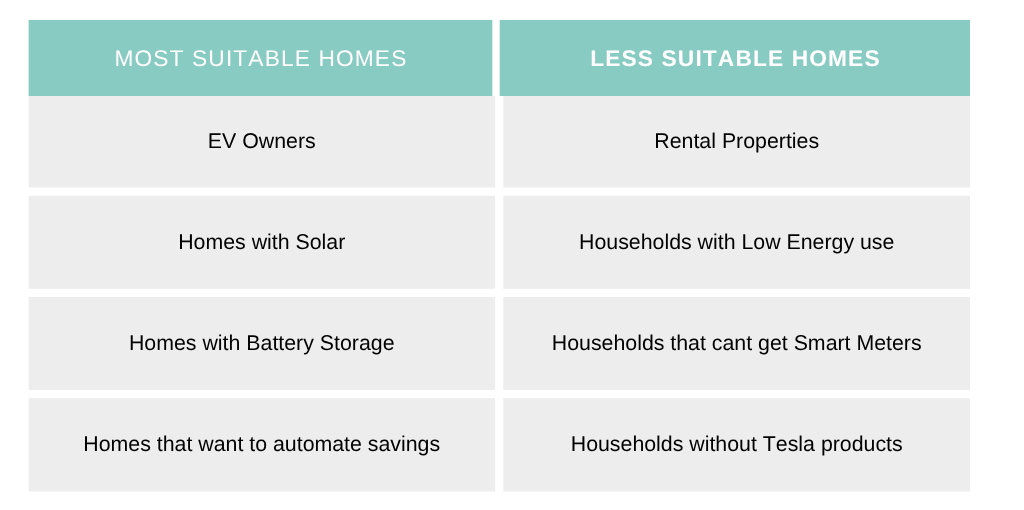
A Tesla energy tariff will be incredibly beneficial for specific types of households. You should consider this deal if:
- You own an electric vehicle: Time-of-use tariffs make charging an EV significantly cheaper.
- You have solar panels and battery storage: If you generate your own power and store it in a system like a Tesla Powerwall, you can maximise your savings.
- You want to automate your savings: Tesla’s software handles the complex optimisation of buying and selling energy automatically.
A Tesla energy tariff is less suitable for households if:
- You are a renter: Installing solar panels or heavy battery units usually requires property ownership.
- You have low energy consumption: If your electricity bills are already very low, the upfront cost of compatible hardware might not pay off.
- You cannot get a smart meter: Dynamic tariffs require a smart meter that sends half-hourly usage data to the supplier.
- You have no existing Tesla products: Tesla Energy UK is likely to mirror Tesla Electric US. Providing energy to homes without Tesla products. However full confirmation of this is yet to be released for UK markets.
How E-Verve Energy Can Help
You don’t have to wait to start building your smart energy ecosystem. Preparing your home now will not only save you on current energy bills. But ensures you are ready to take full advantage of future energy tariffs and incentives such as those anticipated by Tesla Energy UK.
Our team of renewable energy experts have been equipping homes with the latest renewable technology for over 10 years. We are fully Tesla certified and expert installers of the powerful Tesla Powerwall 3. Allowing you to store cheap grid energy or capture your own solar power.
We can also seamlessly integrate your solar and EV charging requirements. Ensuring you generate optimal results from your home energy system.
We are fully MCS Certified and furthermore, our team of experts were named Renewable Energy Installers of the Year. So your in safe hands! Explore our interactive quote builder below and contact us today to future-proof your home and take control of your electricity bills!

Get Your Custom Solar Quote Today
Select your ideal setup and receive a tailored quote in minutes.
140+ Google Reviews