


Perovskite Solar Panels: Solar’s Next Big Thing
The world of renewable energy is constantly evolving, with new technologies promising greater efficiency and lower costs. One of the most exciting developments is in the field of solar power: Perovskite solar panels. This groundbreaking technology is capturing the attention of scientists and energy experts alike, suggesting a future where solar energy is more accessible and powerful than ever before.
This blog will explore the fascinating world of Perovskite solar panels. We’ll uncover what they are, how they stack up against traditional panels, and what hurdles they face before becoming a household name. We’ll also help you decide if you should wait for this new technology or invest in solar power today.
Perovskite: The Miracle Mineral
Perovskite is a calcium titanium oxide mineral with the formula CaTiO3, first discovered in 1839 by Gustav Rose in Russia’s Ural Mountains and named after mineralogist Lev Perovski (1792–1856). Today, the term also applies to synthetic materials with the same crystal structure. About 50 years after its discovery, scientists identified the unique properties of metal-halide perovskites, now used in solar panels. These lightweight, flexible materials are made from organic compounds, metals like lead or tin, and halides combining elements such as bromine, chlorine, or iodine with halogen. They can be crafted into semiconductors highly efficient at converting sunlight into electricity. It wasn’t until 2009 that researchers in Japan successfully integrated them into solar cells, achieving 3.8% efficiency.
What is Perovskite Solar Cell Technology?
Perovskite solar cell technology uses a unique group of materials with a specific crystal structure, similar to that of the naturally occurring mineral perovskite. Scientists synthesise these compounds in a lab to create a ‘perovskite layer’ that can absorb sunlight and convert it into electricity with remarkable efficiency.
Unlike conventional silicon-based solar cells, which require high temperatures and energy-intensive manufacturing processes, perovskite materials can be created at low temperatures. They can even be dissolved into a liquid to create a “solar ink.” This allows manufacturers to print them onto various surfaces, including flexible and lightweight materials. This versatility opens up a world of possibilities for integrating solar power into our daily lives in new and innovative ways.
Perovskite cells can be used by themselves in some applications. They are ultra-thin, meaning they can be sprayed onto surfaces, such as windows, with a number of companies currently piloting this technology. But using perovskites in tandem with silicon gives the benefits of both silicon and perovskites in terms of absorbing the Sun’s energy. Silicon-only cells typically have an efficiency of 21-23% and though improvements are possible, the theoretical maximum is around 33%. In perovskite tandem solar cells the theoretical maximum efficiency increases to more than 47%.
Perovskites Challenges
Critics of the technology worry that perovskite’s greater susceptibility to moisture and heat will mean faster degradation. They are also concerned about perovskites generally containing lead, a toxic substance which can have health and environmental impacts.
Perovskite cell technology is currently still under development with significant barriers preventing their widespread use namely their reduced lifespan due to cell instability and degradation.
Exploring Different Types of Perovskite Solar Cells
The term “Perovskite” refers to the crystal structure, not a single material. Researchers are experimenting with various compositions to enhance performance and stability:
- Organic Perovskites: These cells incorporate organic molecules into the perovskite structure. They are often easier to process but can be less stable than their inorganic counterparts.
- CIGS: While not a perovskite itself, Copper Indium Gallium Selenide (CIGS) is another thin-film technology. Researchers are exploring combining CIGS with perovskite layers to create highly efficient tandem cells.
- Tandem Cells: This is one of the most promising areas. A tandem cell stacks a perovskite cell on top of another type of solar cell, like silicon. The perovskite layer captures high-energy light (like blue and green light), while the silicon layer captures lower-energy light (like red light). This combination can boost overall efficiency beyond what either cell could achieve alone, with some tandem cells surpassing 30% efficiency in labs.
Perovskite-On-Silicon Tandem Solar Cells
Silicon-Perovskite Tandem solar cells as mentioned above are the leading approach in perovskite solar technology. It leverages the established manufacturing infrastructure and proven durability of silicon while adding the high-efficiency potential of a perovskite top layer.
Oxford PV (originating in the University of Oxford over a decade ago) has grown into a global leader in creating perovskite-on-silicon tandem solar cells.
The research and development site of Oxford PV, and its pilot and production line in Brandenburg an der Havel, Germany enable the accelerated transfer of their technology into industrial-scale perovskite-on-silicon tandem solar cell manufacturing.
The main advantage of using perovskites alongside silicon in tandem cells is their ability to capture more of the light spectrum and turn it into energy, thanks to the high mobility of electrons within the cells.
“Our record-breaking solar panels demonstrate that we are on the cusp of the next solar revolution, which will be delivered, in part, by our tandem cell technology.”
Chris Case, Chief Technology Officer, Oxford PV
In 2024, Oxford PV set a world record by creating the most efficient residential-sized solar module, reaching a 26.9% conversion efficiency. Researchers there are aiming to boost the cells’ efficiency by about one percentage point each year. This cutting-edge technology has a theoretical maximum efficiency of over 43%, compared to less than 30% for traditional silicon solar cells.
“This new world record is a crucial milestone for Oxford PV, proving that our tandem solar cells can deliver record-breaking performance when assembled into solar panels.”
David Ward, Chief Executive Officer, Oxford PV
Oxford PV also began commercially shipping its perovskite-on-silicon tandem panels in 2024, focusing on larger-scale customers rather than typical home installations. Right now, availability is pretty limited, with most of the focus on commercial projects, pilot production, and manufacturer-led scale-ups rather than widespread residential sales. The company says its short-term output will go to utility clients, specialty products, and pilot residential projects as it works on ramping up large-scale manufacturing.
Perovskite Solar Panels vs. Mono-Crystalline Panels
When people think of solar panels today, they usually picture mono-crystalline panels. These are the familiar, rigid black panels you see on rooftops. They are the current industry standard, known for their reliability and high efficiency. So, how do Perovskite solar panels compare?
Mono-crystalline panels are made from a single, high-purity silicon crystal. This purity allows electrons to move freely, leading to high efficiency rates, typically between 18% and 22%. They are also incredibly durable, often lasting 25 to 30 years. However, their production is complex and expensive.
Perovskite solar cells, on the other hand, have demonstrated efficiency levels in laboratory settings that meet or even exceed those of mono-crystalline cells. They are also significantly cheaper and less energy-intensive to produce. Their lightweight and flexible nature gives them a distinct advantage in applications where traditional panels are impractical.
The Advantages and Disadvantages of Perovskite Solar Cell Technology
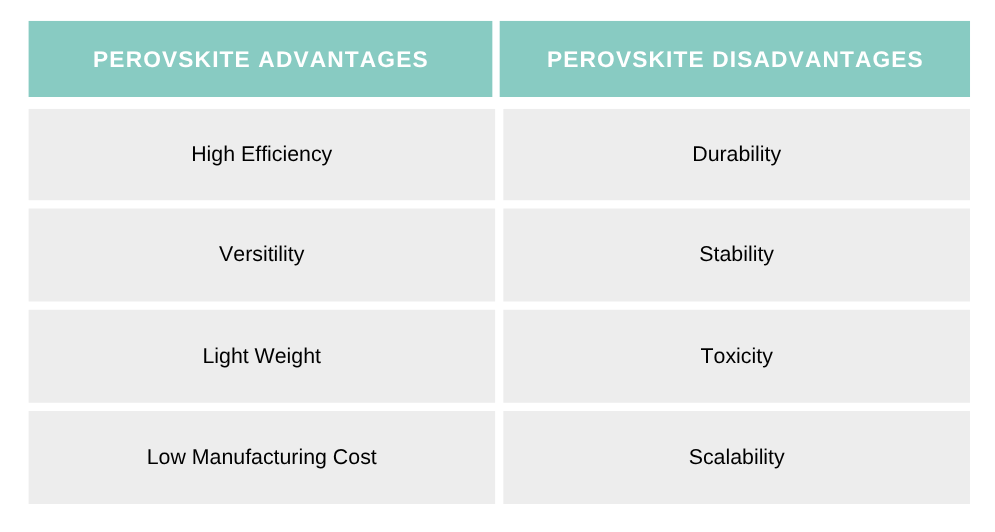
Like any emerging technology, Perovskite solar panels come with a unique set of pros and cons.
Advantages:
- High Efficiency: In research environments, perovskite cells have achieved efficiencies over 25%, rivaling their silicon counterparts.
- Low Manufacturing Cost: The raw materials are abundant, and the production process is simpler and requires less energy than silicon panel manufacturing.
- Versatility: Their ability to be printed onto flexible surfaces means they can be used for solar-powered windows, fabrics, and even vehicles.
- Lightweight: Perovskite cells are much lighter than silicon cells, making them easier to transport and install.
Disadvantages:
- Durability and Stability: This is the biggest challenge. Early perovskite cells degrade quickly when exposed to moisture, oxygen, and heat. While researchers are making progress, long-term stability is not yet proven.
- Toxicity: Many high-efficiency perovskite cells contain lead, a toxic substance. This raises environmental and safety concerns, and researchers are actively working on lead-free alternatives.
- Scalability: Transferring high-efficiency lab results to large-scale, mass-produced panels has proven difficult. Maintaining performance and consistency across larger surfaces is a key hurdle.
When Will Perovskite Solar Panels Be Available?
This is the key question for many homeowners and businesses. While you can’t buy a commercially available Perovskite solar panel for your roof just yet, the technology is moving closer to market. Small, niche products using perovskite cells—like for powering indoor electronic devices—are beginning to appear.
Experts predict that tandem silicon-perovskite panels could become commercially available within the next few years, perhaps as early as 2027. However, for widespread mass-market adoption, the industry must first overcome the significant challenges of durability, toxicity, and scalable manufacturing. It will likely take several years before Perovskite solar panels become a mainstream competitor to traditional silicon panels.
Should You Delay Your Solar Installation?
With such promising technology on the horizon, it’s natural to wonder if you should wait. For most people, the answer is no. Delaying your solar installation means missing out on immediate energy savings and environmental benefits.
The financial case for installing solar now is compelling. Current solar technology is mature, reliable, and more affordable than ever. With rising energy prices, a solar panel system installed today can start paying for itself immediately, significantly reducing or even eliminating your electricity bills. Waiting several years for perovskite technology means you will continue paying high energy costs during that time—money that could have been an investment in your own energy independence.
Conclusion: Your Solar Journey Starts Now
Perovskite solar panels represent a brilliant and exciting future for solar energy. Their potential for high efficiency and low-cost, versatile applications is undeniable. However, they are still a technology of tomorrow, facing real-world challenges that need to be solved.
For those ready to embrace clean energy and enjoy financial savings, the best time to act is now. Today’s solar panel technology is proven, durable, and provides an excellent return on investment. Check out our guide on the Most Efficient Solar Panels for 2026.
At E-Verve Energy Ltd, we specialise in designing and installing high-quality solar solutions tailored to your specific needs. Our expert MCS accredited team can guide you through every step of your solar journey, from the initial consultation to the final installation.
We help you take control of your energy bills with the reliable and effective technology available today. Contact us to find out how you can start saving with solar.

Get Your Custom Solar Quote Today
Select your ideal setup and receive a tailored quote in minutes.
140+ Google Reviews