


kWp Explained: What It Means & Why It Matters
kWp – What It Means & Why its Important
If your looking into solar energy for your home or business you’ve probably searched up kWp meaning and whether it will impact how much electricity your panels will actually produce. Well the short answer is Yes, it does. However you need to fully understand certain nuances in order to make the smartest decision about your solar investment.
What Does kWp Stand For?
Kilowatt- Peak is the full name for kWp. It is the standard unit used to represent the maximum power output of a solar panel or solar system when tested under a controlled set of industry test conditions. The kWp measures power. The kWp rating of a solar PV system tells you what it is capable of generating at its peak performance.
- kilo = 1,000
- watt = a unit of power
- peak = the maximum output under ideal conditions
In a real terms scenario we can breakdown the kWp rating as follows. A 5 kWp solar system is one that can generate up to 5,000 watts of power at peak performance. A single solar panel rated at 500 Wp can output 500 watts at its peak.
kWp and kWh: How They Work Together
So how do the two relate? To put into a worked example, one kilowatt-hour equals one kilowatt of power sustained for one hour. This is the same unit you’ll find on your electricity bill. It’s how you measure how much energy your home consumes or you solar set up actually produces.
The kWh measures energy — it’s the accumulation of power over time, like the total distance traveled. The higher the kWp rating the greater generation capacity of the system. However, your location, roof orientation, and installation quality will determine your actual annual kWh output.
Understanding both values together gives you a realistic expectation of what your system will produce, which directly shapes every financial and practical decision around going solar.
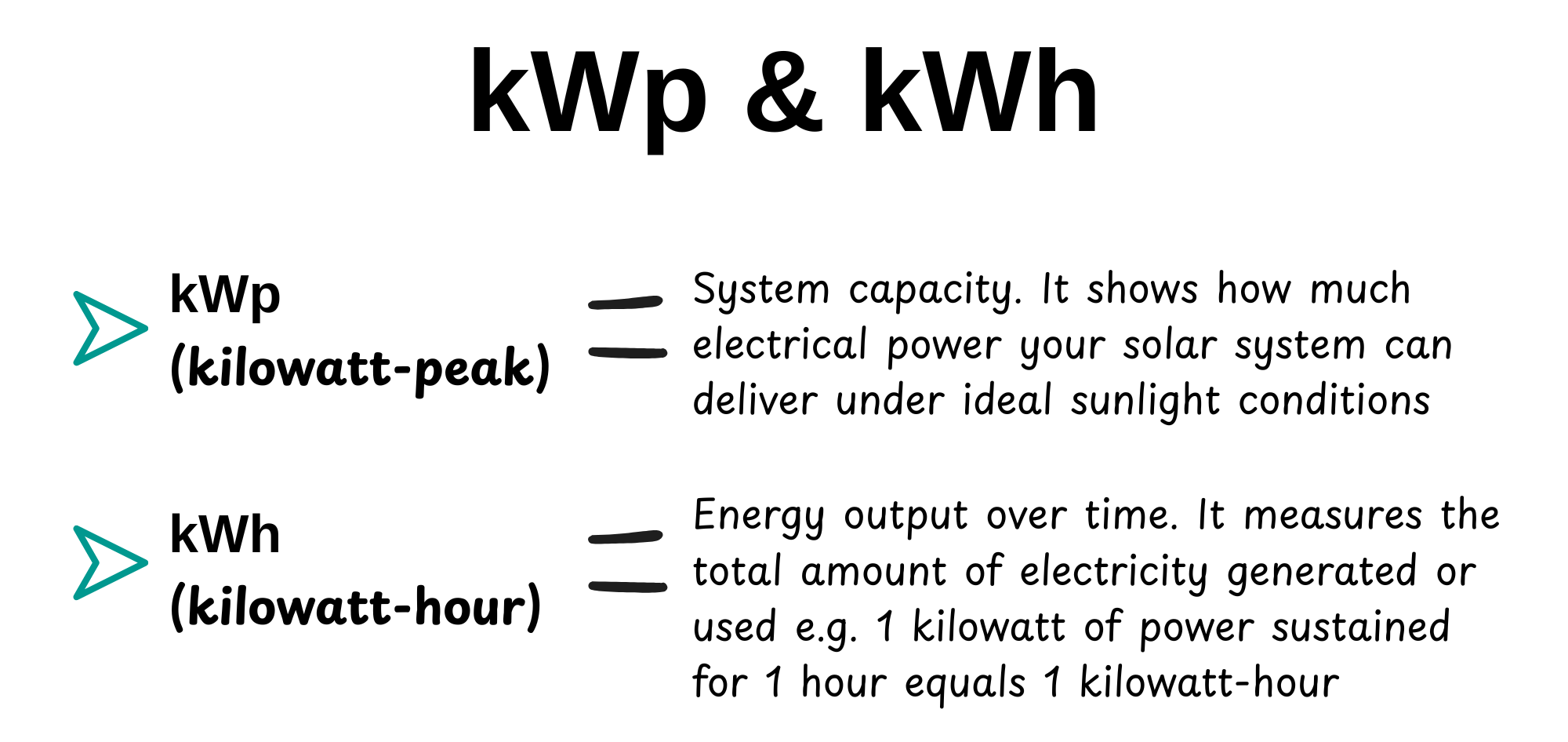
A 4 kWp solar system operating at its full rated output for one hour would generate 4 kWh of electricity. But solar panels don’t run at peak capacity all day. On an average day, you might get the equivalent of 3 to 5 hours of “peak sun hours”. Depending on your location and season. So that same 4 kWp system might realistically generate somewhere between 12 and 20 kWh on a good day.
The relationship between the two is straightforward and the formula is the foundation of PV yield estimation. Which well cover in more detail later.

What Does “Peak” Actually Mean?
Understanding exactly what ‘peak’ refers to in this abbreviation is the key piece of the puzzle.
In kWp ‘peak’ represents the maximum power output a solar panel or solar system can achieve. It is important to remember that this relates to maximum power output under a specific and standardised set of conditions. We’ll cover these conditions referred to as Standard Test Conditions, or STC further on.
In a real life conditions, solar panels rarely operate at their peak rated performance for extended periods. Variables such as shading, panel angle and seasonal weather fluctuations are all factors in impacting actual output.
So the ‘peak’ performance assessment under controlled Standard Test Condition allows for the fair comparison of one panel or system against another.
Standard Test Conditions (STC): The Conditions Behind the kWp Rating
Standard Test Conditions (STC) are the industry wide benchmarks that every solar panel is tested and rated under.
STC’s are deliberately controlled and repeatable to ensure they represent a useful baseline for comparing solar panels across different manufacturers. However as the STC do not reflect real life operating conditions. It bears remembering that the kWp figure alone wont tell you how much electricity your panels or system will be able to generate on a day to day basis. The Standard Test Conditions consist of the following 3 parameters:
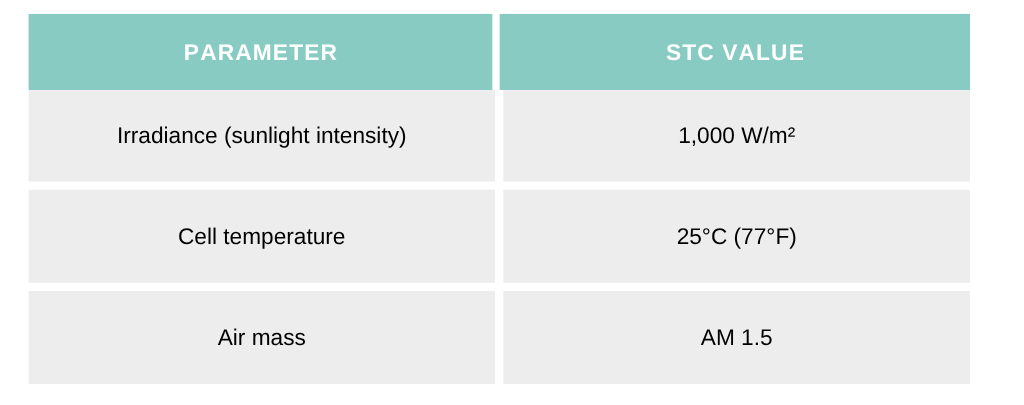
- Irradiance of 1,000 W/m² represents approximately the amount of solar energy hitting the surface of a panel on a clear, sunny day around noon.
- 25°C cell temperature represents a comfortable, moderate temperature — not what you’d expect on a rooftop in summer
- Air mass 1.5 is the angle at which sunlight passes through the atmosphere, equivalent to the sun being about 48° above the horizon
Nominal Operating Cell Temperature (NOCT)Why Real-World Output Differs
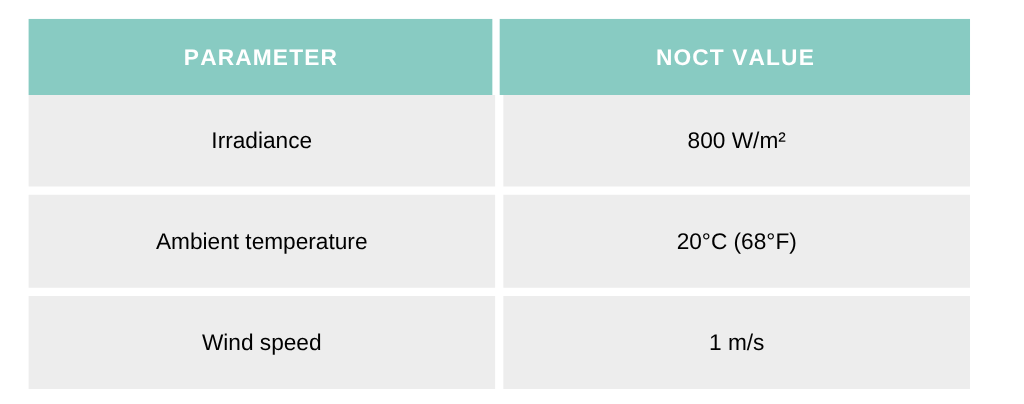
Whilst STC ratings are a necessary standardised comparison tool, the NOCT aims to provide a more realistic performance indicator in real life or field conditions. The NOCT takes into account fluctuating temperatures to provide a more grounded indicator of performance. The Nominal Operating Cell Temperature consists of the following 3 parameters:
So Which is Better – STC or NOCT?
Critics often argue that STC uses standardised values that do not reflect real-life operating conditions. As a result, your system’s actual PV yield can differ significantly from the output predicted by STC ratings. To address this issue, manufacturers developed NOCT to measure performance under more realistic conditions.
So how does the NOCT achieve this? Primarily it accounts for the fact that PV modules heat up a lot more when exposed to real sunlight. The lower irradiance level of 800 watts per square meter assumes a temperature of 45 degrees Celsius which has a notable impact on PV yield. The NOCT also factors in ambient temperature and airflow conditions that more closely mirror what panels experience on a rooftop during a typical operating day.
When designing a solar project and projecting yields both the STC and NOCT should be considered.
PV Yield Explained
.Often referred to as energy yield or solar yield, your PV yield it the total amount of electricity your solar PV system generates over a given time period. It’s usually expressed in kWh per year (or per month, or per day). It is the practical measure of what your solar system actually delivers. It’s what you use to calculate savings on your electricity bill, estimate payback periods, and evaluate whether a system is performing as expected. Factors which will impact your PV yield include:
- Geographic location and solar irradiance data
- Panel orientation and tilt angle
- Shading from trees, chimneys, or neighboring buildings
- Inverter efficiency
- Wiring and conversion losses
- Seasonal variation
The combination of your system’s kWp rating and the expected kWh output over time is what tells you whether a solar system is the right size for your energy needs — and what kind of return you can realistically expect.
kWp Meaning: Key Takeaways
How Can E-Verve Energy Help?
Understanding key terminology such as kWp, kWh, and PV yield is a great start to reviewing your solar requirements. However translating those numbers into the right solar set up for your home or business will always benefit from professional expert advice. That’s exactly where E-Verve Energy can help.
Our team works with you to provide free no obligation preliminary designs and quotations based off your usage and energy goals which include detailed information on kWp. kWh, ROI, yield and potential savings. You can also use our free online quotation tool below to map out a solar array onto your own roof using satellite imaging. Our tool calculates how much energy and savings you could generate and allows you to add additional options such as battery storage.
We are fully MCS accredited and were named Most Trusted Renewable Energy Installers in the North West so you are in safe hands!
Get in touch with us today and take the first step toward a solar system that’s sized, specified, and installed to deliver real results!

Get Your Custom Solar Quote Today
Select your ideal setup and receive a tailored quote in minutes.
150+ Google Reviews