

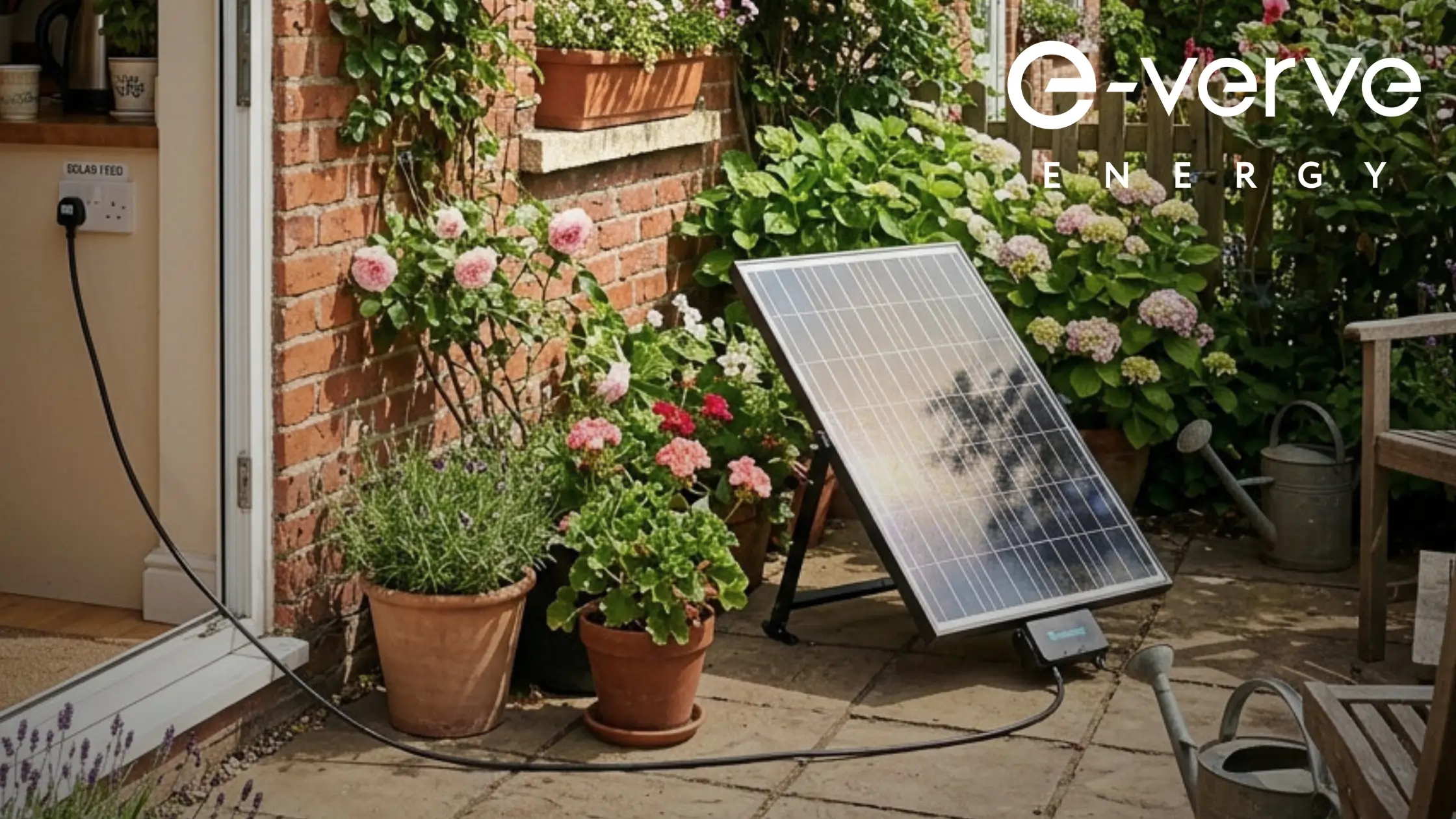
How Do Plug In Solar Panels Work? A UK Guide
How Do Plug In Solar Panels Work
As UK energy bills remain high, plug in solar panels are getting attention as households look for simple ways to cut energy bills. But how do plug in solar panels work? In simplistic terms the way in which the electricity is generated follows the same concept as rooftop panels. Creating direct current (DC) electricity when sunlight hits its cells. However, homes in the UK use alternating current (AC) electricity. So the power has to pass through an inverter before it can be used in the home.
Plug in solar panels usually come packaged together with a small internal inverter inbuilt into the panel itself. The system then connects to a home electrical circuit through a standard UK plug. With a professional MCS certified solar installation a separate more powerful solar inverter is used which is approved to connect safely and directly via new dedicated electrical circuits into the property.
Whilst plug in solar is marketed as a simple, low-cost step into solar energy, and may be initially appealling to those who want to avoid a full rooftop installation. There are still many legal, technical and safety questions for the UK market which we will explore below.
Plug in Solar Panels: Energy Generation
So how do plug in solar panels work to generate energy? Energy is produced by the panels during daytime hours and must be used at the point of generation e.g. to power appliances in your home. Reducing daytime electricity use and thus lowering energy bills as less electricity will be purchased from the grid. However if your household demand is low when the panels are generating electricity. The impact on your bills becomes less significant. This is an issue for households that are not occupied through the day. The simple plug-in design cannot store energy for later use and does not support compatibility with battery storage systems. In terms of energy generation…..
Plug in Solar Panels Work Best When:
In summary plug in panels only reduce your reliability on imported electricity from the grid when they are generating and when your home can use that power at the same time.
This can also be true of some professionally installed rooftop arrays. However, a larger professionally designed and installed system usually has a much greater impact on total imported electricity over the year due to panel size and optimum placement of the panels. A professional MCS solar installer will also be certified to connect to battery storage systems. Maximising savings by enabling you to use your stored electricity when you need it most. Such as when household demand is greatest or electricity prices from the grid are high.
Are Plug-In Solar Panels Legal in the UK?
This is currently the main barrier to plug in panels in the UK. In March 2026, the UK Government announced plans to make sub-800W plug-in solar systems available to buy ‘within months’. Which are expected to range from between £400- £800 per kit. However at present the plug in solar approach is not widely accepted in the UK like it is across many European markets. The main issue around legality is not in regards to solar generation. But how the system connects to your home electrical installation.
The UK is governed by strict electrical safety standards to ensure home circuits are designed and installed in a way that protects people, property and the national electricity grid. The use of circuits which are simply plugged into a standard socket can directly conflict with these standards. This is a cause for concern with regulatory bodies in the UK. As expected standards for electrical compliance and grid safety can be comprised by contravening robust industry installation regulations. So how do plug in solar panels work- can a standard UK socket be used?
UK standard home sockets are not designed to regularly receive electricity back into the electricity circuit. A device such as a plug in solar panel could feed electricity into home circuits in a manner that UK systems were not designed to handle. Therefore updates to electrical legislation including BS7671 and G98 are anticipated prior to retailers releasing products for UK markets.
What Are the Current UK Safety Concerns Surrounding Plug In Solar Panels?
It is important to remember that UK wiring rules, product standards, and grid connection practices are much stricter than the simplistic manner in which plug in solar is marketed. Just because a product is designed to be plugged in does not mean using them with a standard UK socket is recommended or considered best practice. Safety, compliance, and network regulations must be cautiously considered.
A wider concern for UK use is whether plug in solar has the right protections in place for managing any potential export attempt back to the national electricity grid. This situation could arise if your plug in solar system produces more electricity than your home is using at the time of generation. The excess power may attempt to flow elsewhere within your home circuits and towards the grid potentially causing issues for the wider national electricity grid.
Furthermore, the Institution of Engineering and Technology (IET) has warned that some older homes may have wiring or protection devices that were never designed for electricity flowing back into a circuit. Likewise, older RCDs might not function correctly with plug-in generation, potentially reducing shock protection in the event of a fault. Common concerns amongst Governing bodies, standards groups and industry leaders generally include:
- Back-feeding through socket circuits
- Electrical protection and safe isolation
- Compatibility with UK wiring standards
- Risk of improper DIY installation
- Unclear compliance with grid connection requirements
- Potential issues for fire safety and emergency isolation
- Insurance and liability concerns
Which leads to questions around safety in everyday home environments, under real conditions, over time. So whilst plug in systems may be readily advertised online. It does not mean they are currently approved, or compliant for general use in UK homes at present.
Plug In Systems Vs MCS Approved Installations
A small scale plug in solar set up will generate a small amount of energy that may offset a portion of your daytime energy requirements. However it is very unlikely that it will meet your total household demand. Recent Government estimates are suggesting an annual household saving of around £70- £100 per year. Furthermore the energy generated by plug in solar can only be used at the time of generation when your household demand may not be at its highest.
In contrast a professional MCS approved solar installation can often produce more electricity during peak generation than is required at that time. This is where the benefits of battery storage come into play. Allowing this additional energy to be used at a later point for example during the evening when demand may be higher and generation is lower. Thus saving households purchasing more electricity from the grid at peak cost.
SEG Savings
Additionally the MCS certificate you receive for your installation allows you to participate in Government incentives such as The Smart Export Guarantee (SEG Scheme). An MCS certified installation has been confirmed to adhere to robust standards and UK legal requirements thus granting access to participate in schemes such as SEG.
It is for this reason that any professionally installed solar panel system must be MCS certified to engage in any export activity in the UK.
An MCS certified installation provides assurance that compliance and connection standards have been adhered to. Thus protecting the National electricity grid when exports are made. Allowing you to safely export excess electricity back to the grid. Without the potential for risks to the wider safety of the national electricity network. Participaction in the SEG Scheme can also generate income via selling surplus electricity back to the grid.
Without a properly designed and approved system, such as plug in solar panels, or a non MCS Certified or DIY installation. Participation in SEG Scheme is not allowed as exporting excess power may not be safe or acceptable.
Plug-in solar panels may be suitable when:
- You want a very small-scale way to reduce daytime electricity use
- You understand their limits
- You have a suitable sunny space
- You cannot install a full rooftop system
- You are seeking a lower-cost entry point
- You have taken expert advice on legality and safety first
A full MCS professionally installed system may be better when:
- You want the best long-term savings
- You own your home
- You want a system designed around your energy use
- You want battery storage options
- You want clear compliance with UK installation standards
- You want stronger resale confidence, insurance confidence, and long-term reliability
- You want to maximise generation across the year
For many households, a full MCS solar installation is the better choice because it offers scale, safety, and better overall value.
What Is the UK Government and Industry Saying?
In the UK the Government and Industry approach to plug in solar has been rightfully cautious. The main message has been small-scale solar power is welcome and plug in systems will have their place. However they need to be safe, meet regulations, and be properly connected to the electrical system.
In the UK, the Microgeneration Certification Scheme (MCS) is responsible for setting and maintaining standards and providing consumer protection around small scale renewable technologies. MCS provides assurance over the safety of products and their installation ensuring technology is safe, properly connected, and compliant.
However plug in solar set ups are not governed by MCS requirements. This effectively means the consumer has no assurance that the products they are purchasing to ‘plug in’ to their home electricity circuits meet current UK wiring and installation standards.
Industry Bodies and professional installers have stressed that no generation equipment should bypass established standards. Regardless of how small scale or easily installed they are marketed.
The wider message has been:
- Safety must come first
- UK electrical rules still apply
- Grid-connected generation needs proper consideration
- Consumers should not assume a plug-in product is automatically compliant
- Professionally designed and installed systems remain the safer and more established route
As the market develops, standards and guidance may continue to evolve. But for now, caution is sensible and most definitely advised when it comes to plug in solar products. Before purchasing always check the latest government, DNO, manufacturer, and certification guidance for the UK.
How Do Plug In Solar Panels Work: Final Verdict
So, how do plug-in solar panels work? They generate solar electricity, convert it into usable AC power, and aim to reduce the amount of electricity your home imports from the grid while the sun is shining.
That sounds simple, but in the UK, the real issue is not just how they work. It is whether they can be used safely, legally, and effectively within the rules that apply to home electrical systems.
They may look like a cheap and easy fix for high bills, but they come with important questions around socket use, compliance, export, and protection. Their generation is usually limited, and their impact is much smaller than a professional MCS solar installation.
How Do Plug in Solar Panels Work: Key Takeaways
- Plug-in solar panels generate electricity from sunlight and feed it into your home’s electrical system
- They are marketed as low-cost and easy to use but that is not necessarily the case for UK use
- In the UK, legality and safety regulations in regards to plug in solar panels are currently under review
- Using standard UK home sockets for plug-in solar panels raises major concerns
- Electricity generation is usually very modest from plug in panels
- If they generate more power than you need, excess electricity may create export and compliance issues
- Plug in solar panels can not be paired with battery storage systems
- If they do not generate enough, your home simply draws the rest from the grid
- A professionally installed MCS solar panel system is in general safer, more powerful, and better for long-term savings
- The best option depends on your property, your energy use, and your goals
How E-Verve Energy Can Help
If you’re considering solar for your home and want professional and trusted advice we can help you to determine the best options for your budget. We provide free no obligation preliminary designs and quotations based off your usage and energy goals which include detailed information on ROI and potential monthly savings. If your unsure whether a plug in product or a professional MCS solar installation is the right option for you, our experts will provide guidance on safety, compliance and long term value.
Alternatively you can use our free online quotation tool below to map out a solar array onto your own roof using satellite imaging. Our tool calculates how much energy and savings you could generate and allows you to add additional options such as battery storage.
We are fully MCS accredited and were named Most Trusted Renewable Energy Installers in the North West so you are in safe hands!
/

Get Your Custom Solar Quote Today
Select your ideal setup and receive a tailored quote in minutes.
150+ Google Reviews