
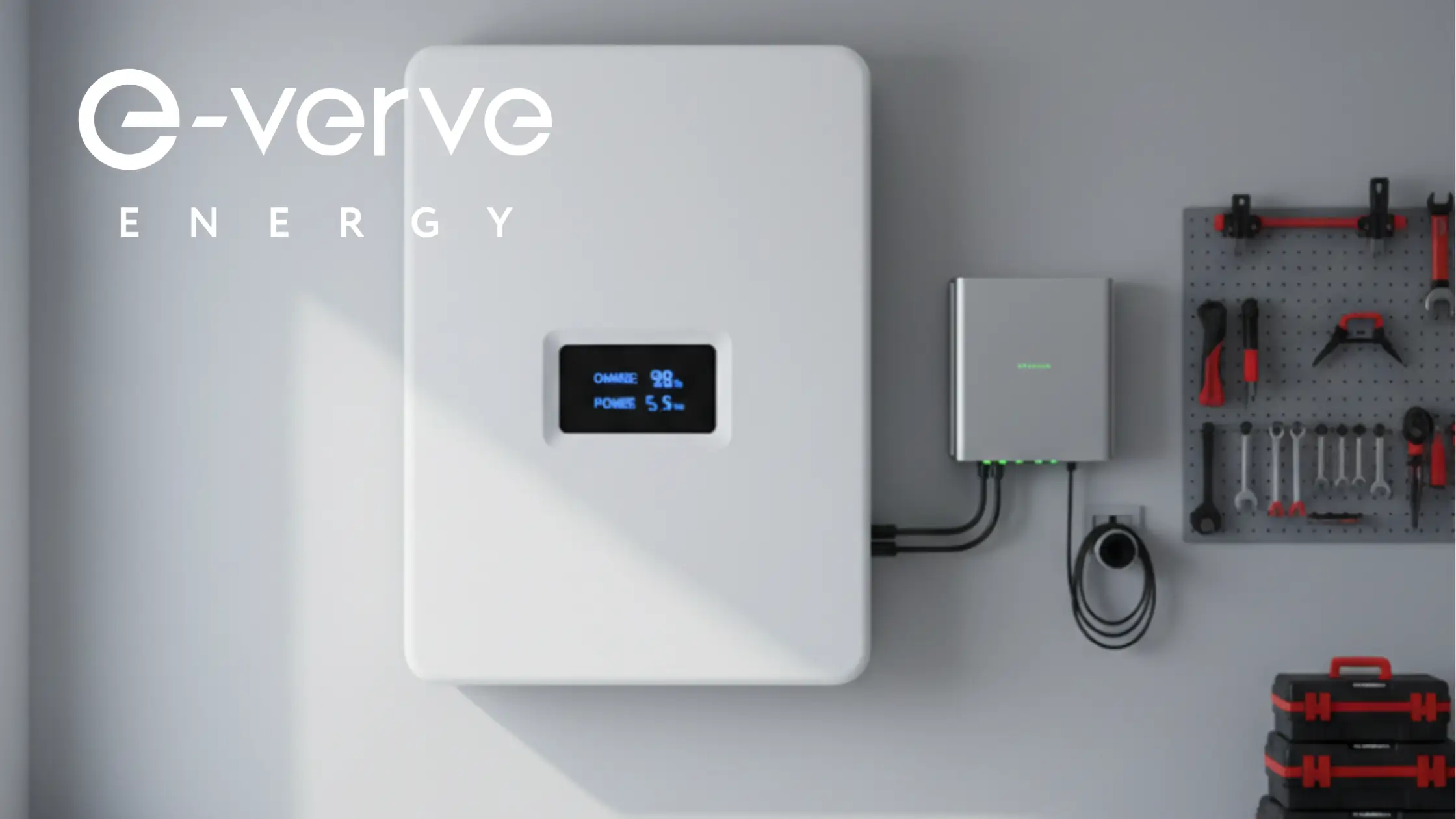
home battery storage fitted in garage by e-verve energy #homebattery #homebatterystorage #homebatterystorageuk

Home Battery Storage Systems and How They Work

Home battery storage is changing how UK households manage their energy. By storing electricity generated from solar panels or the grid, these systems offer a way to reduce bills, increase energy independence, and support a greener future. If you’re considering a home battery, our guide will walk you through everything you need to know.

What is Home Battery Storage?

A home battery storage system is essentially a large, rechargeable battery that connects to your home’s electrical system. Its primary job is to store electricity for later use. This allows you to capture excess energy, typically from solar panels during the day, and use it in the evening when the sun has set. It acts as your personal energy reserve, giving you more control over your power consumption.

How Do Home Battery Storage Systems Work?

The process is straightforward but clever. When your solar panels produce more electricity than your home is currently using, the surplus energy is directed to the home battery instead of being sent back to the grid. The battery stores this energy as direct current (DC).

When you need to use this stored power, an inverter converts the battery’s DC electricity into alternating current (AC), the type of electricity used by your household appliances. A smart management system decides when to store energy, when to power your home from the battery, and when to draw from the grid, optimising for the lowest cost and greatest efficiency.

Different Types of Home Battery Storage Systems

Choosing to add a home solar battery to your energy system is a major step toward energy independence and lower bills. But once you start looking, you’ll find a surprising variety of technologies available. Not all batteries are created equal, and the right choice for your home depends on your budget, space, and performance expectations.

For most UK homeowners, Lithium-ion batteries, particularly the ultra-safe LFP (Lithium Iron Phosphate) variants, offer the best combination of performance, lifespan, and value. They are compact, efficient, and require no maintenance.

While older lead-acid technology might seem tempting due to its low initial price, its short lifespan and poor performance make it a less economical choice in the long run. Meanwhile, exciting new technologies like sodium-ion promise a future of even more affordable storage, and vanadium flow batteries show what’s possible at a massive scale.

Lithium-Ion (Li-ion) Batteries

When people talk about modern batteries, they are usually thinking of Lithium-ion. This is the same technology that powers your smartphone, laptop, and most electric vehicles. In the world of home solar batteries, Li-ion is the dominant and most popular choice, known for its good balance of performance, size, and cost.

Pros:
  • High Energy Density: Li-ion batteries can store a lot of energy in a small, lightweight package. This makes them ideal for homes where space is limited.
  • High Efficiency: They have excellent round-trip efficiency, typically over 90%. This means very little energy is lost during the charging and discharging process.
  • Long Lifespan: A well-maintained Li-ion battery can last for 10-15 years and endure thousands of charge cycles.
  • Low Maintenance: These batteries are a “set it and forget it” solution, requiring no regular upkeep.
Cons:
  • Higher Cost: The upfront cost is generally higher than older technologies like lead-acid.
  • Thermal Runaway Risk: While rare, Li-ion batteries can be susceptible to thermal runaway (uncontrolled overheating) if damaged or improperly managed, though modern battery management systems make this extremely unlikely.
  • Best Suited For: Nearly all residential solar installations. If you’re looking for a reliable, compact, and efficient home battery, a standard Li-ion option is likely the best all-around choice.

Lithium Iron Phosphate (LiFePO4 or LFP)

Lithium Iron Phosphate is a specific type of lithium-ion battery that has gained significant traction in home energy storage. It uses a different cathode material (iron phosphate) which gives it a distinct set of characteristics, prioritizing safety and longevity above all else.

Pros:
  • Exceptional Safety: LFP chemistry is much more stable than other lithium-ion types. It is not prone to thermal runaway, making it one of the safest battery technologies available.
  • Very Long Cycle Life: LFP batteries can often handle more than double the number of charge cycles compared to standard Li-ion batteries, potentially lasting up to 20 years.
  • No Cobalt: The production of LFP batteries does not rely on cobalt, a metal with significant ethical and environmental mining concerns.
Cons:
  • Lower Energy Density: They are slightly larger and heavier than other Li-ion batteries of the same capacity.
  • Slightly Higher Cost: The upfront investment can be marginally higher than standard Li-ion, though this is often offset by their longer lifespan.
  • Best Suited For: Homeowners who prioritize safety and long-term value. If you have the space and your primary concern is installing the most durable and secure system possible, LFP is an outstanding choice.

Sodium-Ion Batteries

Sodium-ion batteries are an emerging alternative to lithium-based technologies. Instead of lithium, they use abundant and inexpensive sodium to carry the charge. While not yet as common in residential settings, they represent a promising future for home energy storage due to their cost and material advantages.

Pros:
  • Low Cost Materials: Sodium is one of the most abundant elements on Earth, making these batteries potentially much cheaper to produce than lithium-ion.
  • Excellent Safety: Like LFP, sodium-ion batteries are very stable and have no risk of thermal runaway.
  • Wide Operating Temperature: They perform well in both very hot and very cold conditions, which can be a limitation for some lithium-ion types.
Cons:
  • Lower Energy Density: They are currently bulkier and heavier than lithium-ion batteries, requiring more installation space.
  • New Technology: As a newer technology, there are fewer manufacturers and a shorter track record in the residential market.
  • Best Suited For: Budget-conscious early adopters and off-grid applications where space is not a major constraint. As this technology matures, it could become a leading contender for home storage.

Vanadium Flow Batteries

Vanadium flow batteries are a completely different kind of energy storage system. Instead of storing energy in solid electrodes, they use two large tanks of a liquid electrolyte solution. Energy is stored and released by pumping the liquid past a membrane.

Pros:
  • Nearly Unlimited Lifespan: Flow batteries do not degrade in the same way solid-state batteries do. They can be cycled tens of thousands of times with virtually no loss of capacity. Their lifespan is estimated at 20+ years.
  • Scalability: To increase storage capacity, you simply need to use larger tanks of electrolyte. The power output and energy capacity are independent of each other.
  • Very Safe: The electrolytes are water-based and not flammable, making them extremely safe.
Cons:
  • Very Large and Heavy: The need for tanks and pumps makes these systems significantly larger and more complex than other battery types, making them unsuitable for most typical homes.
  • High Cost and Complexity: The initial cost and installation complexity are high, which has limited their use to large commercial and utility-scale projects.
  • Lower Efficiency: They tend to have lower round-trip efficiency compared to lithium-ion.
  • Best Suited For: Large-scale commercial properties, industrial applications, or utility grid storage. They are generally not practical for residential home solar batteries.

Lead-Acid Batteries

Lead-acid batteries are the oldest and most familiar type of rechargeable battery technology. They are the same type of battery found under the hood of most conventional cars. For decades, they were the go-to choice for off-grid solar systems, but they have largely been surpassed by newer technologies for residential use.

Pros:
  • Low Upfront Cost: Lead-acid batteries are the cheapest type of solar battery to buy initially.
  • Proven Technology: They are a well-understood and reliable technology that has been in use for over a century.
Cons:
  • Short Lifespan: They have a much shorter lifespan than lithium-ion, typically lasting only 3-7 years.
  • Low Depth of Discharge (DoD): You can typically only use about 50% of a lead-acid battery’s total capacity without causing significant damage and shortening its life.
  • Bulky and Heavy: They have a very low energy density, meaning they are large, heavy, and require a lot of space.
  • High Maintenance: Flooded lead-acid batteries require regular maintenance, including checking water levels and cleaning terminals.
  • Safety Concerns: They contain corrosive acid and can release explosive hydrogen gas during charging, requiring good ventilation.
  • Best Suited For: DIY projects, small off-grid systems where cost is the absolute primary driver, or as a backup power source that is rarely cycled. For most modern home solar systems, the long-term cost and hassle are not worth the initial savings.

How Much Do Home Batteries Cost?

The cost of a home battery storage system in the UK varies based on several factors, including capacity, brand, and installation complexity.

As a general guide, an entry-level 4kWh to 5kWh lithium-ion battery, installed as part of a complete solar panel system, typically costs between £2,000 and £3,000. Larger capacity batteries, such as a 10kWh model, can range from £3,000 to £4,000 or more.

It’s often more cost-effective to install a battery at the same time as your solar panels. Retrofitting a battery to an existing system can be more expensive because it requires separate labour and potentially a new or hybrid inverter.

Take Advantage of 0% VAT

To encourage the adoption of green technology, the UK government has introduced a significant financial incentive. Until March 31, 2027, the installation of energy-saving materials, including home batteries installed with solar panels, qualifies for a 0% VAT rate. This can result in substantial savings on the total cost of your system. This relief also applies to standalone battery installations, making it an excellent time to invest.

Professional Installation

It is essential to have a professional installation of battery storage systems to ensure compliance with UK regulations and adherence to manufacturers recommendations.

Home battery units are surprisingly compact. Most are designed to be wall-mounted or floor-standing and are similar in size to a small boiler or a piece of carry-on luggage. They can be installed in a garage, utility room, or another dry, sheltered location.

Proper ventilation is important to ensure the battery operates within its ideal temperature range. Crucially, recent updates to electrical regulations (BS 7671) now prohibit the installation of home battery systems in high-risk areas like lofts or main escape routes due to fire safety considerations. Your installer will advise on the safest and most compliant location in your home.

Home Battery Storage Capacity

The right size home battery depends on your household’s daily energy consumption and the output of your solar panel system. A typical UK home uses around 8-10 kWh of electricity per day.

A qualified installer can perform a detailed analysis to recommend a battery capacity that perfectly matches your needs without being excessive. A 6-10 kWh battery is often sufficient for average homes, but larger households or those with high electrical consumption items such as air source heat pumps or electric vehicles may benefit from a 10 – 20kWh+ system.

Start by analysing your bills, defining your goals and considering your future needs. To learn more check out our recent blog.

Can I Have a Battery Without Solar Panels?

Yes, you can install a home battery storage system without having solar panels by installing an AC Coupled battery storage system . These systems can be configured to charge from the grid. This allows you to take advantage of cheaper off-peak electricity tariffs, such as Economy 7 or Octopus Go. You can charge your battery overnight when electricity is cheapest and then use that stored energy during peak hours, effectively avoiding the highest energy prices.

An AC-Coupled battery solution requires an inverter to convert DC electricity to AC for use in the home. Due to this the overall price will increase as no Hybrid inverter is present to accommodate both solar panel and battery storage connections. An entry-level 4kWh to 5kWh AC-Coupled system typically costs between £4,000 and £5,000. Larger capacity batteries, such as a 10kWh model, can range from £5,000 to £6,000 or more.

Home Solar Batteries Lifespan

Most modern home batteries use lithium-ion technology and are designed for longevity. The average lifespan of a home battery is between 10 and 15 years. This is typically defined by the number of charge-discharge cycles the battery can complete before its capacity significantly degrades. Most leading manufacturers provide a warranty that guarantees the battery will retain a certain percentage of its original capacity (usually 70-80%) after 10 years or a specific number of cycles.

To learn more about the lifespan of solar batteries and what factors can influence longevity check out our blog.

Final Thoughts

A home battery storage system is a powerful investment in your home’s energy future. It provides greater energy independence, lower electricity bills, and a smaller carbon footprint. By storing your own clean energy, you can protect yourself from rising grid prices and contribute to a more sustainable energy network.

How E-Verve Energy Can Help?

At E-Verve Energy, we specialise in designing and installing bespoke home energy solutions. We are officially The Most Trusted Solar Panel Installers of 2024 and with over 10 years in the Industry your in safe hands! We are fully MCS accredited, TrustMark approved and proud members of both RECC and CPA. This means that all projects are fully protected and completed by our accredited tradesmen. What this means for our customers:

  • We will assess your current and future energy requirements
  • We will provide a detailed comparison of leading products and models, explaining warranties, maintenance needs, and optimal system configurations
  • We offer professional installation and ongoing support for maximum battery lifespan

We make installation simple and stress-free, making sure your system is safe, compliant, and performing at its best. Reach out today to discover how you can take control of your energy with a home battery storage system.

Get Your Custom Solar Quote Today

Select your ideal setup and receive a tailored quote in minutes.

140+ Google Reviews

Have more questions?

That’s okay, we’ve answered some of the more commonly asked questions here but if you still have questions, just get in touch and we’ll be happy to provide any support you need.

The short answer is yes. You absolutely can install a home battery storage system without having solar panels on your roof.

While we often see solar panels and batteries paired together, they don’t have to be a package deal. Standalone home battery storage is becoming an increasingly popular option for UK households looking to cut energy bills and gain independence from volatile energy prices.

If you are renting, live in a flat, or simply don’t like the look of panels, a standalone battery might be the energy solution you didn’t know you needed. Let’s explore how it works, why it saves money, and whether it’s the right investment for you.

How Does Home Battery Storage Work Without Solar?

When you have solar panels, a battery stores the free energy generated during the day for use at night. Without solar, the process is slightly different but just as clever.

Instead of capturing sunlight, a standalone home battery connects directly to the National Grid. It acts like a reservoir for electricity. The “magic” happens through smart time-of-use tariffs.

Many energy suppliers in the UK now offer tariffs with significantly cheaper rates during off-peak hours (usually overnight, between 12:00 AM and 05:00 AM). A standalone battery system is programmed to charge up during these cheap windows and then discharge that stored power during the day when electricity prices are highest.

Essentially, you are buying low and selling high—but instead of selling to someone else, you are “selling” it to yourself to avoid paying peak prices.

The “Load Shifting” Advantage

This process is known as “load shifting.” You shift your home’s energy demand from expensive peak times to cheap off-peak times.

  • Charge: 2:00 AM @ 7p per kWh
  • Discharge: 6:00 PM (when standard rates might be 24p+ per kWh)

By running your washing machine, TV, and lights off the battery during the evening, you pay the overnight rate for night-time usage.

Key Benefits of Standalone Home Battery Storage

Why would someone choose a home battery without the added benefit of generating their own power? There are several compelling reasons.

1. Access to Smart Tariffs

The UK energy market is evolving. Agile and time-of-use tariffs reward consumers who can be flexible with their energy usage. A battery gives you ultimate flexibility without you having to change your lifestyle. You don’t have to wait until midnight to run the dishwasher; the battery handles the cost savings for you.

2. No Roof Required

Solar panels aren’t for everyone. You might live in a conservation area, a listed building, or a flat with no roof rights. Or perhaps your roof faces north and simply isn’t efficient for solar. A home battery takes up very little space—about the size of a small suitcase—and can be installed in a utility room, garage, or under the stairs.

3. Energy Security and Backup

Power cuts are rare, but they happen. Many modern home battery storage systems come with Emergency Power Supply (EPS) capabilities. If the grid goes down during a storm, your battery can keep critical circuits running, keeping your lights on and your freezer cold.

4. Lower Initial Investment

Solar panel arrays are expensive to install. By opting for just the battery, you significantly reduce the upfront installation cost and scaffolding requirements while still accessing energy savings.

Financial Feasibility: Is It Worth It?

This is the big question. Does the math stack up?

The return on investment (ROI) for a standalone battery depends heavily on the “spread” or difference between your peak and off-peak electricity rates.

  • High Spread: If your night rate is 7p and your day rate is 30p, the savings are substantial. A 5kWh battery cycled once a day could save you over £1.00 daily, or £365+ a year.
  • Low Spread: If you are on a standard flat-rate tariff, a standalone battery makes zero financial sense. You would be storing expensive electricity to use later, losing a tiny bit of efficiency in the process.

Cost Considerations

A typical AC-coupled battery system (ideal for homes without solar) costs between £4,000 and £5,000 depending on capacity and installation complexity.

Unlike solar systems, where the payback is often calculated over 15-20 years, batteries have a shorter lifespan (typically 10-15 years). You need to calculate if the annual savings from load shifting will pay off the unit cost within its warranty period.

VAT Update

It is important to note the current VAT situation. As of February 2024, the UK government expanded the 0% VAT relief to include standalone home battery storage systems. Previously, you only got the tax break if you bought panels at the same time. This 20% saving makes the standalone option much more financially attractive than it was a few years ago.

Who Should Get a Battery Without Solar?

A standalone home battery storage UK setup is ideal for:

  • Apartment dwellers: People who cannot install solar but want green tech.
  • High evening users: Households that are empty during the day but use lots of power (cooking, gaming, heating) between 5 PM and 9 PM.
  • EV owners: If you already have an electric vehicle and a smart charger, you are likely already on a tariff that supports cheap overnight charging. Adding a house battery is a natural next step.

Final Thoughts

Can you have a battery without solar panels? Yes. Should you? That depends on your tariff.

If you are willing to switch to a smart, time-of-use energy tariff, a standalone battery is a brilliant way to “hack” your energy bills. It offers a lower barrier to entry than a full solar system and provides immediate savings from day one. However, if you prefer sticking to a standard flat-rate tariff, a battery on its own will likely just be an expensive wall ornament.

For many UK homeowners, the standalone battery is the unsung hero of the energy transition—quietly saving money in the cupboard under the stairs, no sunshine required.

The answer is a resounding yes, but with an important condition: the system must have the right technology installed.

When the grid goes down, safety regulations require your home to disconnect from it. This is to prevent the power you generate from flowing back into the utility lines, which could endanger line workers making repairs.

For your solar battery to work during a power cut, it needs a system that can safely isolate your home from the grid. This is typically achieved through one of these components:

Integrated inverter with backup functionality

Many modern batteries come as all-in-one units with a built-in inverter. This component turns the DC power from the battery into AC power for your home. The important part is that the inverter should have a built-in transfer switch to detect a grid outage and automatically disconnect your home..

Backup Gateway or Smart Switch

This is a separate piece of hardware installed alongside your battery and main electrical panel. The gateway acts as the brain of the operation. It constantly monitors the grid connection. The moment it detects an outage, it physically disconnects your home from the grid and signals the battery to start supplying power. This transition is often so seamless you might not even notice the power went out.

Islanding

This term refers to the ability of your solar and battery system to form its own independent, self-sustaining microgrid. When the main grid fails, your system “islands” itself, allowing your solar panels to continue generating power to run your home and recharge your battery, even during an extended outage.

Without one of these mechanisms, your battery system will shut down with the grid as a safety precaution.

Examples of Solar Batteries with Backup Power

Many top battery manufacturers build their products with strong backup features. Here are a few standout options that deliver reliable power when the lights go out:

  • Tesla Powerwall 3
  • Sigenstor Battery by Sigenergy
  • Fox ESS AC-Coupled Battery Systems

To learn more about Backup Power check out our recent blog: UK Power Blackout Warnings: Am I at Risk?

If you were an early adopter of solar energy, you’ve likely enjoyed years of lower electricity bills and the satisfaction of powering your home with sunshine. But as energy prices fluctuate and technology advances, you might be asking yourself a new question: “Can I add home energy storage to my existing solar panels?”

The simple answer is yes. Retrofitting a battery to an existing solar array is not only possible; it is one of the most common upgrades for solar owners today. However, it’s not as simple as plugging a battery into a wall socket. There are several technical and practical factors to consider before you make the investment.

This guide will walk you through the key considerations, the different connection methods, and the benefits of upgrading your system with home energy storage.

Key Considerations for Adding Storage

Before you buy a battery, you need to understand how it will fit into your current setup. Here are the most critical factors to evaluate.

1. System Compatibility: Inverters and Battery Types

Your existing solar system consists of panels and an inverter. The inverter is the “brain” that converts DC electricity from panels into usable AC electricity for your home.

When adding a battery, compatibility depends heavily on your current inverter.

  • Standard String Inverter: If you have a standard inverter, it likely cannot connect directly to a battery. You will either need to replace it with a hybrid inverter or add a separate battery inverter.
  • Hybrid Inverter: If you were forward-thinking and installed a “battery-ready” hybrid inverter, adding storage is often much simpler and cheaper.

You also need to ensure the battery chemistry (usually Lithium-ion or Lithium Iron Phosphate) is compatible with the inverter you plan to use.

2. AC-Coupled vs. DC-Coupled Systems

This is the most important technical decision you will face. There are two main ways to connect a battery to an existing system:

AC-Coupled Systems

In an AC-coupled system, the battery is installed as a separate unit with its own inverter. It connects to your home’s main AC electrical supply.

  • Best for: Retrofitting. This is the most popular choice for adding storage to existing panels because it doesn’t require you to mess with your current solar inverter or wiring.
  • Pros: Flexible placement, easier installation, and compatible with almost any existing solar system.
  • Cons: Slightly less efficient due to multiple AC-to-DC conversions.
DC-Coupled Systems

In a DC-coupled system, the battery connects directly to the solar panels before the energy is converted to AC. This usually requires replacing your old inverter with a new hybrid inverter.

  • Best for: Systems where the old inverter is nearing the end of its life (10+ years old) or new installations.
  • Pros: Higher efficiency because energy is converted fewer times.
  • Cons: Often more expensive upfront if you have to replace a perfectly good existing inverter.
3. Battery Size and Capacity

Don’t just buy the biggest battery you can afford. The right size depends on your energy usage and your solar generation.

  • Generation: If your panels generate 15kWh a day but you use 10kWh during the day, you only have 5kWh of “spare” energy to store. A 10kWh battery would be a waste because you’d rarely fill it.
  • Usage: Conversely, if you want to run a heat pump or charge an EV overnight, you might need a larger capacity to cover those loads.

A professional installer can analyze your smart meter data to recommend the “Goldilocks” size—not too big, not too small.

4. Backup Power Capabilities

Many homeowners assume a solar battery storage system automatically works during a power cut. This is a myth. Most standard setups shut down during a blackout for safety reasons (to protect line workers).

If you want backup power, you must specify this upfront. It requires additional hardware, such as an automatic transfer switch or a dedicated “emergency circuit” and an inverter capable of “islanding” your home from the grid.

5. Energy Monitoring

Adding a battery adds complexity. You need a way to see what your system is doing. Modern storage solutions come with app-based monitoring that shows you exactly how much energy you are generating, storing, and using in real-time. Ensure your new battery system integrates well with these platforms so you can track your ROI.

The Benefits of Adding a Battery

Why go through the trouble of upgrading? The benefits of adding home energy storage to existing panels are substantial.

Increased Energy Independence

Without a battery, you are likely exporting up to 50% or more of your solar energy back to the grid during the day, only to buy expensive electricity back at night. A battery lets you keep what you generate, significantly reducing your reliance on utility companies.

Greater Cost Savings

By storing your free solar energy for evening use, you avoid paying peak-time electricity rates. Additionally, with a smart battery, you can charge from the grid during cheap overnight windows (e.g., 7p/kWh) and discharge during peak times, increasing your savings even on cloudy days.

Environmental Impact

Using more of your own green energy means your home draws less power from the grid, which is often still fueled by gas or coal power plants. A battery maximizes the carbon-reducing potential of the panels already sitting on your roof.

Final Thoughts: Is It Worth It?

Adding home energy storage to your existing solar panels is a smart move for most modern households. While the upfront cost is a consideration, the long-term savings and energy security make it a compelling upgrade.

If your current inverter is relatively new, an AC-coupled solution is likely your best bet. If your inverter is aging, swapping it for a hybrid DC-coupled system could give your entire solar setup a new lease on life.

The key is not to guess. Consult with a certified installer who can assess your current system and energy habits. With the right battery, you can turn your daytime solar power into a 24/7 energy solution.

Once your home battery is charged, the stored energy is automatically used to power your home whenever your solar panels aren’t generating enough electricity, such as at night or on very cloudy days. This process is seamless. You won’t notice any difference in your power supply; your lights and appliances will run just as they normally would. The system’s software manages the flow of energy, ensuring you use your stored, free electricity before drawing from the expensive national grid.