

Ground Mounted Solar Panels: The Complete Guide & Benefits
The Ultimate Guide to Ground Mounted Solar Panels
While rooftop solar often steals the spotlight, not every property has the perfect roof for energy generation. Enter ground mounted solar panels—a flexible, high-efficiency alternative that is gaining popularity for both residential and commercial projects. If you have the land space, moving your solar array to the ground can unlock better angles, easier maintenance, and potentially higher energy yields.
So, what exactly are ground mounted solar panels? Put simply, they are solar arrays installed directly on the earth rather than on a building’s structure. They use a sturdy framework of racks or poles to hold the panels at the optimal tilt and orientation. By freeing yourself from the constraints of your roof’s shape and shading, you can position these panels to capture sunlight perfectly throughout the day.
Types of Ground Mounted Solar Panels
Ground mounted solar panels offer superior efficiency and flexibility compared to rooftop installations. If you have available land, this option allows you to perfectly optimise your energy generation. But not all ground-mounted systems are the same. Choosing the right mounting structure depends on your soil type, budget, and energy goals.
We’ll explore an overview of the main types of ground-mounted solar panel systems you can choose from below. Covering fixed-tilt mounts, single-axis trackers, and dual-axis trackers to help you understand which solution is right for your energy goals.
Standard Fixed-Tilt Systems
The most common and cost-effective type of ground-mounted solar is the standard fixed-tilt system. As the name implies, the panels are mounted on a rigid frame at a fixed angle and orientation.
How It Works
During installation, the frame is set to face south to capture the maximum amount of sunlight throughout the day. The tilt angle is also carefully calculated and set based on the UK’s latitude. The goal is to find a “sweet spot” angle that provides the best year-round performance, balancing the low winter sun with the high summer sun. Once installed, this angle does not change.
Features and Benefits
Best Suited For
Standard fixed-tilt systems are the ideal choice for most residential properties and small-scale commercial projects. They are perfect for homeowners who want a dependable, low-cost solar solution and have a clear, unshaded area with a good southerly aspect. If your primary goal is a strong return on investment with minimal fuss, this is likely the system for you.
Other Considerations: Ballasted and Pole-Mounted Systems
Within the fixed-tilt category, you may also encounter a few other variations:
- Ballasted Systems: Instead of driving posts into the ground, these systems use heavy concrete blocks or trays filled with ballast to hold the array in place. They are useful for sites where excavation is not possible, such as on brownfield sites or landfills.
- Pole Mounts: This involves mounting a smaller number of panels on top of a single, tall pole. Presenting a good solution for small arrays where you want to minimize the ground footprint or elevate the panels above potential obstructions.
Single-Axis Trackers
For those looking to boost their system’s energy output, a single-axis tracker offers a significant step up in performance. This system introduces movement to follow the sun’s path across the sky.
How It Works
Panels are mounted on a structure that rotates on a single axis, typically from east to west. Then a motor, controlled by a sophisticated program, slowly tilts the panels throughout the day. In the morning, the panels face east to greet the rising sun. They gradually track its path across the sky, remaining perpendicular to the sun’s rays, until they face west in the evening.
Features and Benefits
Best Suited For
Single-axis trackers are an excellent option for large residential properties, farms, and commercial operations where maximizing energy output is a priority. They are especially valuable for users with high electricity demands or those looking to sell excess energy back to the grid. While the upfront cost is higher, the increased energy generation can lead to a faster payback period.
Dual-Axis Trackers
Dual-axis trackers represent the pinnacle of solar panel efficiency. These systems offer complete freedom of movement, tracking the sun both horizontally and vertically.
How It Works
A dual-axis tracker moves on two separate axes. Like a single-axis system, it tracks the sun from east to west throughout the day. However, it also adjusts its vertical tilt to account for the sun’s changing height in the sky, which varies dramatically between summer and winter. This allows the panels to maintain a perfect, direct orientation to the sun at all times.
Features and Benefits
Best Suited For
Dual-axis trackers are typically reserved for large-scale commercial or utility projects where maximizing output is the only goal. The complexity, higher cost, and increased maintenance requirements make them less common for residential installations. They are best deployed in settings like solar farms or for businesses with extremely high, constant energy needs where the significant upfront investment is justified by the massive gains in generation.
How Are Solar Panels Installed on the Ground?
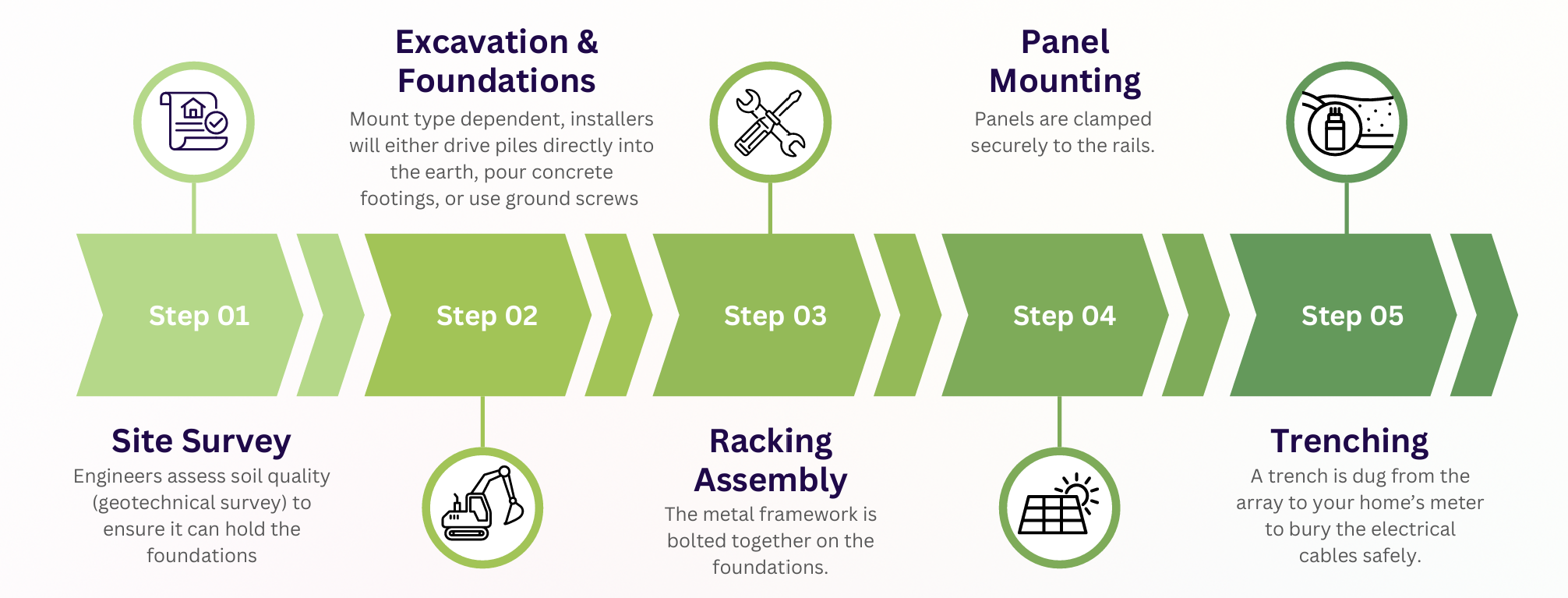
The installation process is more involved than rooftop solar because it requires civil engineering or ground works. Solar panel support frames need to be mechanically fixed to concrete bases or even with screws piled into the ground to prevent overturning. Below ground electrical ducting typically provides a route to the point of grid connection from the ground mounted solar array. Local electrical distribution cabinets may also be required providing additional circuit protection, isolation and control for electrical apparatus.
When it comes to picking a solar panel to pair with your ground mount system , Bi-facial solar panels are uniquely suited. Bi-facial solar panels capture sunlight on both the front and back. The back side captures light reflected off the ground (albedo light). This increases total energy yield without requiring more space. However, these panels require a reflective surface below (like white gravel or snow) to be truly effective. If your planning a high-efficiency ground array installed over light-colored surfaces, then these panels are an ideal pairing.
Future Technologies in Ground Mounted Solar
Floating Solar (Floatovoltaics): As land becomes scarce, we are seeing solar moving to water. These arrays float on reservoirs or lakes. They reduce water evaporation and the cooling effect of the water boosts panel efficiency.
AI and IoT Integration: Smart ground mounted solar panels are becoming a reality. Integrated IoT sensors can now detect micro-shading issues or mechanical faults in real-time. AI algorithms can then adjust tracking mounts automatically to avoid shadows or stow panels safely during high winds.
Ground Mounted vs. Roof Mounted Solar Panels
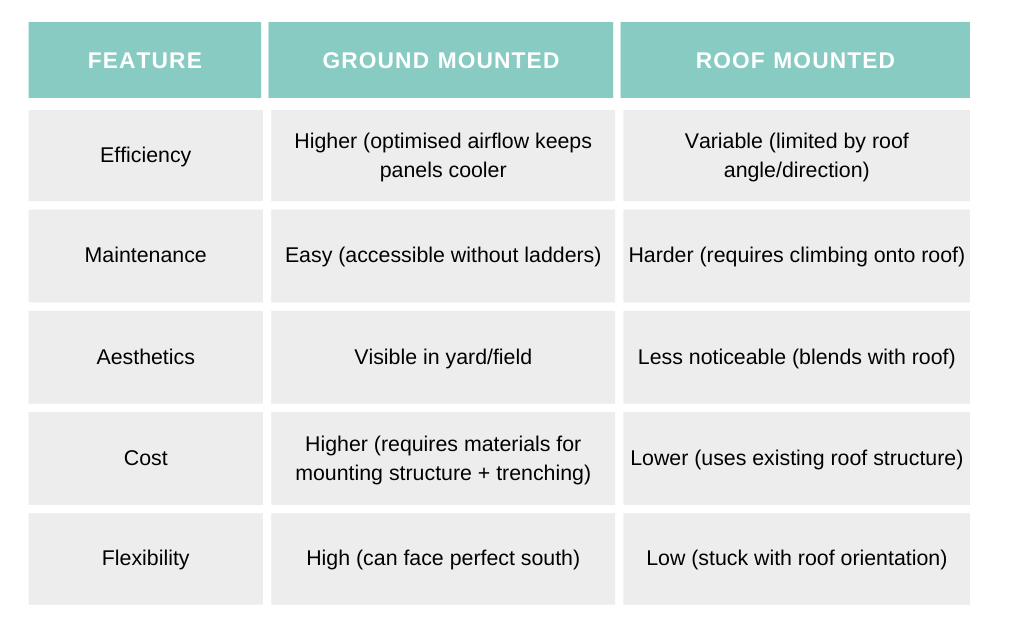
Deciding between ground mounted and rooftop solar panels is a critical step in your renewable energy journey. While rooftop installations are common, they are not always the best fit. Ground mounted solar panels offer a powerful alternative, but are they the right choice for your specific situation? This section will help you evaluate if a ground-based system aligns with your property and energy goals.
Scenarios Where Ground Mounted Solar Panels are Preferable
A ground-mounted system is often the ideal solution when your roof presents certain limitations or when you want to maximize your system’s performance without compromise. Here are the key scenarios where ground mounting shines.
Your Roof Space is Limited or Unsuitable
Not all roofs are created equal. You might have a complex roofline with multiple dormers, vents, and skylights that leave little room for a solar array. Older roofs may lack the structural integrity to support the weight of the panels, requiring expensive reinforcements before an installation is possible. In these cases, using available land space is a far more practical approach. A ground-mounted system bypasses these issues entirely, moving your energy generation to an open area.
Your Roof’s Orientation or Shading is Suboptimal
For maximum energy production, solar panels should ideally face south with an unobstructed view of the sky. However, many homes have roofs that face east or west, which significantly reduces the total sunlight captured throughout the day. Furthermore, tall trees, neighboring buildings, or chimneys can cast shadows on your roof, crippling your system’s output. Ground mounted solar panels give you the freedom to choose the perfect location on your property—one that is free from shade and oriented for peak solar exposure all day long.
You Want to Maximise Energy Efficiency
Ground mounted systems consistently outperform their rooftop counterparts in terms of efficiency. This is due to two main factors: optimal tilt and better cooling.
- Optimal Tilt: An installer can set your ground-mounted panels at the precise angle for your latitude, maximizing year-round energy harvest. Rooftop panels are limited by the pitch of your roof.
- Superior Airflow: Panels get hot in the sun, and heat reduces efficiency. Ground-mounted arrays have ample space for air to circulate underneath, which keeps them cooler and operating closer to their peak performance. Rooftop panels have limited airflow, causing heat to build up between the panel and the roof.
You Plan for Future Expansion or Have High Energy Needs
If you plan to buy an electric vehicle or add more energy-intensive appliances in the future, a ground-mounted system offers scalability that a roof cannot. It is much easier and more cost-effective to add more panels to an existing ground rack than to try and squeeze more onto a crowded roof. This makes ground-mounted solutions a future-proof investment for those with growing energy demands.
Product Spotlight: Leading Ground Mount Solutions
At E-Verve Energy, we partner with top-tier manufacturers to ensure your system withstands the elements for decades. Below are the technical specifications for the market-leading solutions we recommend.
Schletter PV-MaxS Kit
The Schletter FS (PV-MaxS) system offers economic efficiency and durability with its steel construction. It suits residential projects particularly well, where quick installation is essential.
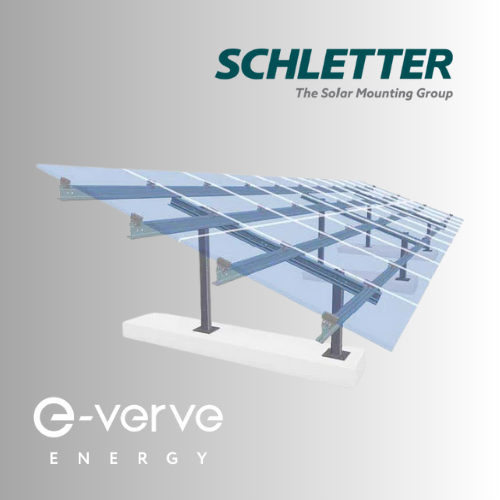
- Material Construction: High-tensile hot-dip galvanized steel profiles for superior corrosion resistance.
- Foundation Compatibility: Can be installed using pile-driven foundations (rammed posts) or concrete foundations, making it adaptable to various soil densities.
- Structural Integrity: Engineered to withstand significant wind and snow loads standard to Northern Europe.
- Tilt Capability: Offers fixed tilt angles typically ranging from 10° to 35°, allowing installers to optimize for local latitude.
- Assembly: Features a modular design with pre-drilled components, significantly reducing on-site construction time.
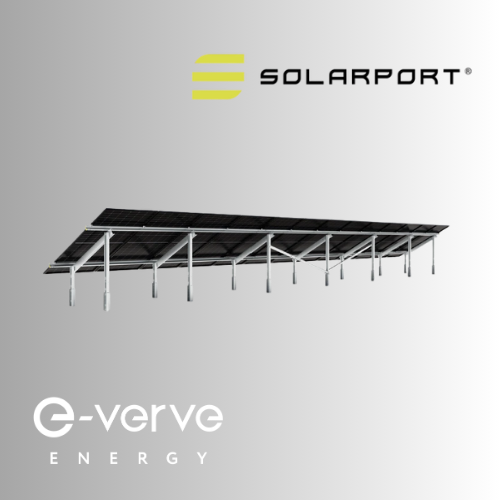
Solarport 1-in-Portrait Twin-Post Ground Mount Kit
This system is a robust solution designed for high stability in exposed areas. The “Twin-Post” design offers extra rigidity compared to single-post alternatives.
- Configuration: 1-in-portrait (panels are arranged vertically in a single row), which minimizes shading issues between rows.
- Material Specs: Manufactured from Z600 galvanized steel, offering a self-healing protective layer that prevents rust even if the surface is scratched.
- Panel Compatibility: Universal clamping system accommodates all standard frame heights (30mm-50mm), making it compatible with the vast majority of modern 60 and 72-cell modules.
- Wind Rating: Tested for high wind zones, capable of withstanding gusts typical in coastal or open-field environments.
- Cable Management: Integrated cable routing channels along the rails to protect wiring from wildlife and weather.
RADIX SolarMount Racking System
RADIX changes the game for difficult terrain. This system integrates seamlessly with ground screw technology, completely eliminating the need for concrete.
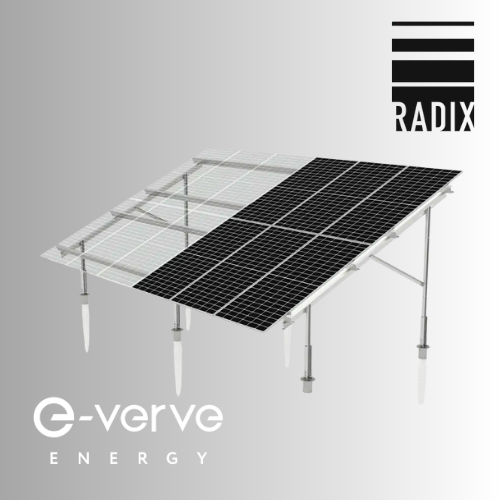
- Foundation Technology: Uses the RADIX Ground Screw system. These large screws provide immediate load-bearing capacity without digging, pouring concrete, or waiting for it to cure.
- Environmental Impact: Low-carbon installation. The screws can be removed and the ground returned to its original state easily, making it ideal for temporary sites or eco-conscious owners.
- Terrain Flexibility: The adjustable screw heads allow for precise leveling even on sloping or uneven ground (up to 20-degree gradients).
- Durability: The racking is composed of high-grade anodized aluminum and stainless steel components, ensuring a lifespan that matches or exceeds the 25-year warranty of most solar panels.
Do You Need Planning Permission for Ground Mounted Solar Panels?
Navigating red tape is often the biggest concern for homeowners. In the UK, the good news is that ground mounted solar panels often fall under Permitted Development Rights, meaning you do not need a full planning application. However, strict limitations apply. To qualify without planning permission, your installation generally must:
If you live in a Conservation Area, a National Park, or near a Listed Building, Permitted Development rights are often removed. In these cases, you will almost certainly need to submit a formal planning application. Always consult your local planning authority before breaking ground.
Are Ground Mounted Solar Panels More Efficient?
The short answer is yes. Ground mounted systems typically outperform rooftop counterparts for two key technical reasons: Orientation and Temperature Coefficient.
First, a roof is fixed. If your roof faces East or West, it caps your generation potential. A ground mount points perfectly South (or optimizes for your specific latitude) to capture the maximum solar irradiance.
Second, solar panels lose efficiency as they get hot. Rooftop panels often have only a few inches of clearance, trapping heat between the panel and the roof tiles. Ground mounted panels are open on all sides. This allows wind to circulate freely underneath (the “chimney effect”), keeping the cells cooler. For every degree Celsius a panel cools down, its voltage and power output increase.
How Much Space Do They Need?
Ground mounted solar panels are not small. They require a significant footprint, not just for the panels themselves, but for the necessary spacing to prevent self-shading.
For a typical 4kW residential system (which might consist of roughly 10 to 12 modern panels), you generally need about 20 to 25 square meters of clear land.
However, you cannot simply measure the panel area. You must account for the “exclusion zone” around the array. If you place the panels too close to a hedge, fence, or tree, you risk shading the array during winter months when the sun is low in the sky. Shading on even one panel can disproportionately drop the output of the entire string. Therefore, the actual functional space required is often larger than the physical dimensions of the rack.
Does the Array Need to Be Close to the Property?
While you don’t need the panels right next to your back door, distance comes with a cost. The electricity generated by your panels must travel to your home’s inverter and meter through underground cables.
As electricity travels through a wire, it faces resistance, leading to voltage drop. To combat this over long distances, you must use thicker, more expensive cabling (often armored cable for underground safety).
- Under 50 meters: Usually straightforward and cost-effective.
- 50 to 100 meters: Viable, but cable costs rise significantly.
- Over 100 meters: Possible, but you may lose efficiency or require very expensive heavy-gauge copper or aluminum cabling to make the system worthwhile.
Most installers recommend keeping the array within 50 meters of the grid connection point to maximize return on investment.
How Can E-Verve Energy Help?
Ground mounted solar panels offer a powerful path to energy independence for those with the space to accommodate them. They offer superior efficiency, easier maintenance, and the freedom to maximise solar harvest regardless of your roof’s design.
Whether you are considering a high-tech tracking system or a robust rack mount team E-Verve is here to help. We can conduct site surveys, handle the complex groundworks, and install a system tailored to your land and energy needs.
From the first consultation through installation and aftercare, we deliver expert advice, high-quality workmanship, and ongoing support—helping you make the most of your investment!
Reach out to E-Verve Energy- The Most Trusted Renewable Energy Installer of 2024! today to discover how we can help you get the most out of your solar panels!
Have more questions?
That’s okay, we’ve answered some of the more commonly asked questions here but if you still have questions, just get in touch and we’ll be happy to provide any support you need.