


Are Solar Batteries the Only Choice for Home Energy Storage?
Solar Batteries or Energy Arbitrage – Which is Best for You?
If you’re interested in home energy storage but don’t have a solar array to hook up solar batteries don’t worry- standalone batteries are most definitely still worth considering. Standalone home energy storage batteries can still generate significant savings for your household via a process called energy arbitrage which we’ll explore below.
While solar batteries are designed to pair perfectly with solar panels, modern battery systems are flexible enough to provide plenty of benefits on their own. Providing both savings to your monthly energy bills and offering protection during power outages.
How Do Home Energy Storage Batteries Work Without Solar Panels?
Home energy storage batteries installed without solar panels don’t produce their own power. This is because they are not connected to a solar generating array. Referred to as ‘standalone batteries’, instead, they pull electricity straight from the utility grid. But how is this beneficial to the homeowner? The concept around standalone batteries as oppose to solar batteries is to benefit from fluctuating electricity prices throughout the day.
A standalone battery without solar panels or a solar inverter requires an AC-coupled battery system. AC- coupled batteries have either a separate or a built in inverter controlling the battery only, allowing connection to your home’s main electrics without solar panels.
The battery’s inbuilt software then monitors changes in electricity price. Either via tariff data inputted by the owner or via smart integration with energy providers. Charging itself up during off-peak hours when electricity costs are lowest. Then, during peak times when electricity rates go up, your home can use the power already stored in your standalone battery. Instead of purchasing at peak rates from the grid. This approach, called energy arbitrage or time-of-use shifting, can help you save a lot on your utility bills without the need for solar panels and solar batteries at home.
Pros and Cons of a Standalone Battery System
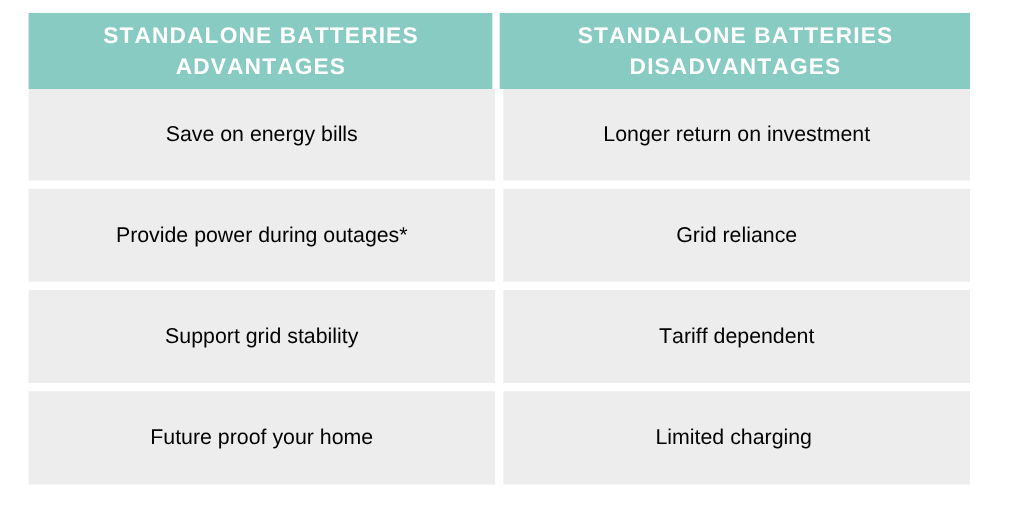
Installing a standalone battery and utilising energy arbitrage can provide significant benefits without the addition of solar panels. However standalone batteries do come with their own set of both benefits and drawbacks which we’ll explore below:
Advantages
- Cost Savings on Utility Bills: By charging with cheap, off-peak electricity and using it during expensive peak times, you can lower your overall energy costs via energy arbitrage using a time of use tariff (TOU).
- Backup Power During Outages*: When installed with additional components such as home back up gateways, a standalone battery has the ability to provide power supply during blackouts. It can keep your essential appliances like refrigerators, lights, and medical devices running. Offering peace of mind and security. *You need to have an adequate level of stored energy already within the battery for this to work. It is not possible to charge your battery from the electricity grid during power outages.
- Grid Stability: Using batteries in this way can help reduce strain on the electrical grid during peak demand periods. Some utility companies even offer incentives for customers who participate in demand response programs. Which shift power to the grid at peak load times.
- Future-Proofing Your Home: Install a battery now, and you can easily add solar panels later to generate more savings than energy arbitrage alone can achieve. The core infrastructure is already in place, simplifying a future transition to a full solar-plus-storage system.
Disadvantages
- Higher Upfront Cost: Solar batteries are a significant investment. Without the energy generation from solar panels to offset the cost. The return on investment (ROI) using energy arbitrage may be longer.
- Reliance on the Grid: The grid powers standalone batteries by charging them with electricity. This means your energy isn’t coming from a renewable source. So you won’t be reducing your carbon footprint in the same way you would with solar panels.
- Dependent on Tariff Structure: The financial benefits heavily depend on your energy suppliers tariff options. Which could be subject to change over time. If there is little difference between your off-peak and peak electricity prices, the savings will be minimal so you need to shop around for the best value.
- Limited Charging: A standalone battery can only charge when the grid is active.
Battery Models for Standalone Installation
Most modern AC-coupled batteries work great even without solar panels. Offering the flexibility to connect directly to your home’s electrical system. Some newer solar battery products also have an in-built inverter with Solar Panel connections known as MPPTs available. These provide flexibility to connect Solar panels directly into the battery at a later date.
Here are a few excellent examples of standalone batteries that can allow for savings via energy arbitrage and back up during outages:
- Tesla Powerwall 3: The Powerwall is a popular name in energy storage. Known for being an AC-coupled battery that works great on its own and also as a Hybrid solution. Allowing Solar Panel connection to be made at a later date. With smart software for easy time-of-use management and smooth backup power during outages when adding a Gateway. The Powerwall 3 is both practical and reliable. It has a flexible in-built inverter allowing capacities to be set ranging between 3.68kW – 11.04kW and 13.5 kWh battery storage capacity. Making it a strong all-in-one option.
- Sigenstor Battery by Sigenergy: Sigenergy designed Sigenstor as a powerful all-in-one modular LFP battery system that you can act as a standalone AC-coupled battery. The inverter capacities are fixed therefore you need to suitably size to future proof for any later additions. Such as Solar Panels or additional solar battery capacity. The system allows both 9.0kW and 6.0kW battery storage capacities to be mixed within the same stack. Making it perfect for homeowners who want to start with battery storage and add solar down the road.
- Fox Solar Battery: Fox ESS provides a variety of AC-coupled battery storage solutions perfect for retrofits. They’re easy to install in homes without solar panels. Offering backup power and helping to reduce energy costs through time-of-use optimisation.
Conclusion
Installing a standalone home battery without solar panels is becoming a popular choice for homeowners. It’s a smart way to cut electricity costs with time-of-use rates.
Ultimately, the decision to install a standalone home battery comes down to your personal goals and situation. If your main focus is to keep peak electricity costs under control via energy arbitrage and provide power during an outage. A standalone battery could be a great option for you.
Alternatively if your aim is for longer term energy independence and reducing your carbon footprint, then a battery with full solar panel array would be the better choice.
Either way our team of renewable energy experts at E-Verve Energy can help you make the best choice for your home.
We can help you analyse your utility bills, assess your energy needs, and determine whether a standalone battery or full solar array with storage is the best option for you. You can access free quotations for both options using our interactive no obligation quote tool below. This will allow you to map out potential solar arrays onto your own roof using satelitte imaging. As well as generating information on return on investment and potential monthly savings.
Our team of experts are fully MCS accredited and were named Most Trusted Renewable Energy Installers so you’re in safe hands!
Contact us today for expert no obligation advice and see how much you could save!
Get A Custom Quote From Local Solar Installers
Select your setup and receive your tailored solar quote instantly.
150+ Google Reviews